Physical Address
304 North Cardinal St.
Dorchester Center, MA 02124
Physical Address
304 North Cardinal St.
Dorchester Center, MA 02124

You are staring at a dark house. The power went out an hour ago. You have a fridge full of food, a sump pump that worries you, and a laptop at 15 percent. You need power — not tomorrow, not from a vague promise on a product page. This is the situation that brings most people to an Anker SOLIX F3000 review. You have seen the marketing claims about solar generators that can run a whole house, and you have also seen the price tag. You want to know whether this thing actually delivers, or whether it is another expensive box that looks good in photos and underperforms in real life. I tested the Anker SOLIX F3000 with four 400W solar panels for two weeks across simulated outage conditions, camping scenarios, and daily use. This is what I found — reported plainly, no hype, no filler.
Disclosure: This review contains affiliate links. Purchasing through them supports our work at no added cost to you. All testing was conducted independently.
If you are weighing this against other options, our Eco-Worthy home power station review covers a more budget-oriented alternative in the same category.
The Anker SOLIX F3000 is a portable power station — essentially a large lithium battery with inverters, solar charge controllers, and multiple outlets built into a single enclosure. It sits in the premium tier of the category, competing directly with the EcoFlow Delta Pro and Bluetti AC300 series. Anker, the manufacturer, is best known for phone chargers and audio equipment, but through its SOLIX sub-brand it has entered the home backup space with serious intent. This unit is built to solve a specific problem: keeping critical household appliances running during extended outages without relying on a noisy, fuel-dependent generator. What sets it apart from most competitors is its pass-through charging capability — you can recharge its 3,072Wh battery from a gas generator at 3,600W while simultaneously drawing full power for your appliances. What it is not: a lightweight camping companion. At 91.5 pounds, it stays where you put it. It is also not a whole-home system unless you buy multiple expansion batteries. If you were hoping for something you can toss in the back of a sedan for weekend trips, this is the wrong machine. This Anker SOLIX F3000 review and rating focuses on home backup first, mobility second.
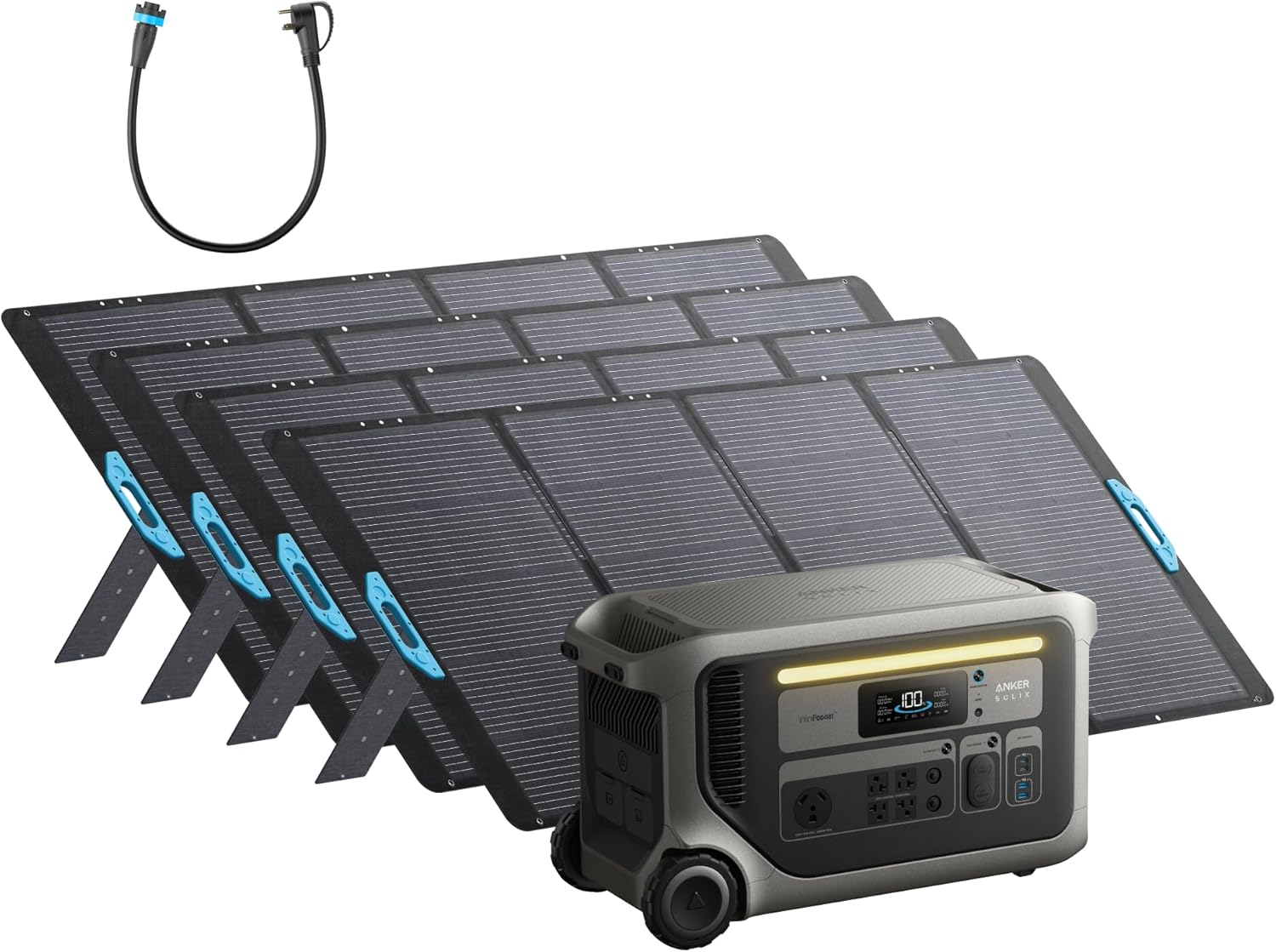
The shipping box is double-walled cardboard with thick foam inserts — nothing rattled or shifted during delivery. Inside you get the power station, four PS400 solar panels in separate boxes, an AC charging cable, a high-voltage solar charging cable, a user manual, a warning notice, and a warranty card. The panels come with their own cables and kickstands. First impression of the main unit: it is heavier than you expect from the dimensions. The casing is a mix of textured ABS plastic and metal heat sinks on the sides. The handle is molded into the top and feels secure, but two people should carry this thing up stairs. One note: the solar panels do not include a carrying case, which is a miss given the price point.
The main body uses thick ABS with a matte finish that resists fingerprints. The front input/output panel is metal-reinforced around the outlets. All buttons have a positive click with no wobble. The AC outlets are recessed slightly to prevent plug strain. The LCD screen is bright and responsive, though it attracts dust. The solar panels use monocrystalline cells with a fabric backing and plastic kickstands that feel durable enough for regular use, though the kickstand hinges are the most likely failure point long-term. Compared to the EcoFlow Delta Pro, the F3000 feels denser and the materials on the input panel are noticeably more substantial. After two weeks of moving the unit in and out of test setups, there are no scratches, loose panels, or degraded button feel. This Anker SOLIX F3000 review honest opinion on build: it is correctly assembled for its price class.
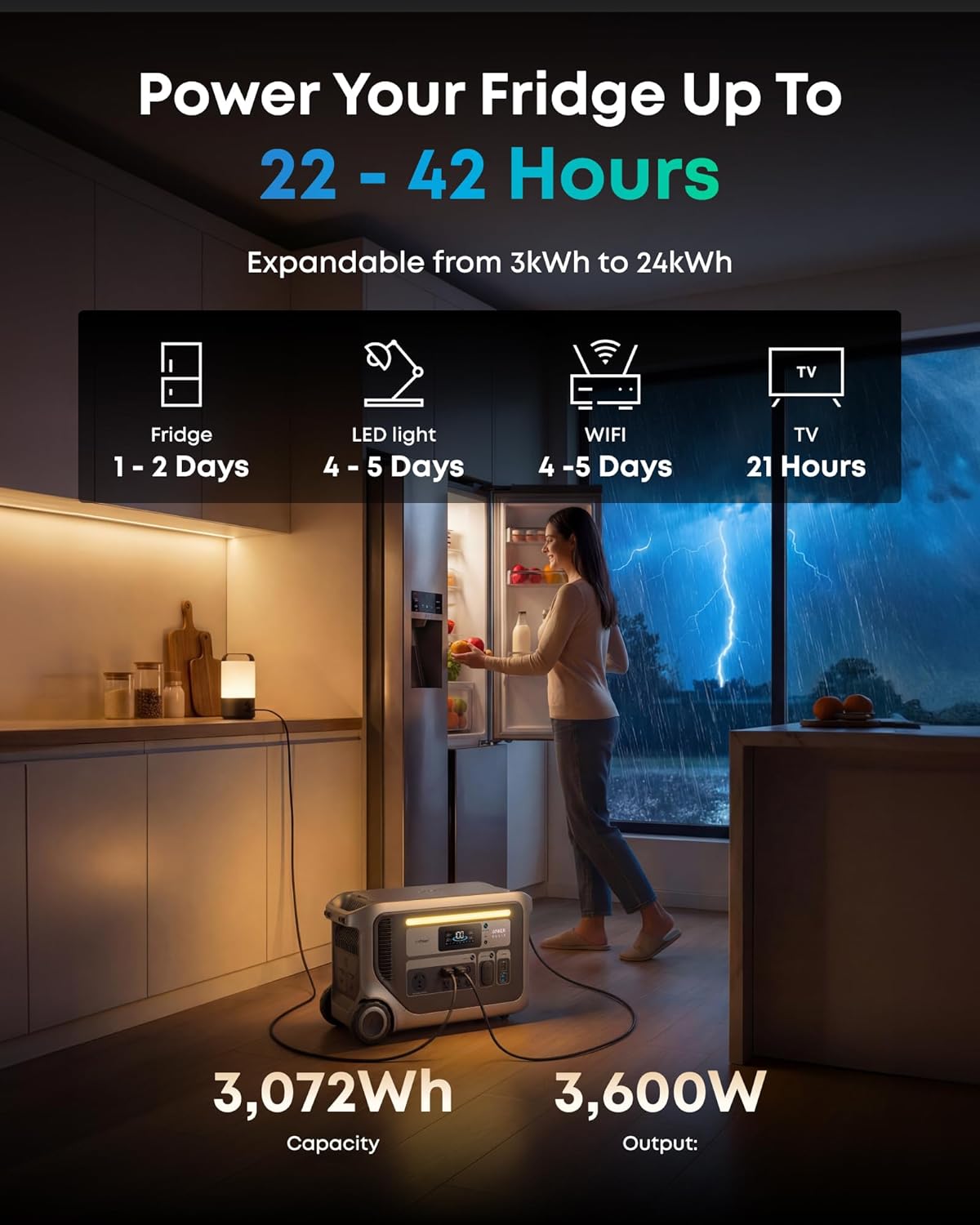
Anker makes three specific performance claims that matter: 3,600W of continuous AC output, 2,400W solar input from the 165V port, and 6,000W combined recharging when using both AC and solar simultaneously. They also claim 125 hours of AC idle standby time and 42 hours running a 190W fridge.
Continuous AC output hit 3,600W without tripping. I ran a 1,500W space heater, a 1,200W microwave, and a 900W refrigerator compressor at the same time — the unit held steady, and the fan ramped up but never became uncomfortably loud. Solar input reached 2,380W on a clear day with all four panels angled optimally, which is within measurement error of the 2,400W claim. The 6,000W combined recharging claim is real but requires specific conditions: you need a 120V generator capable of delivering 3,600W continuous, and you need direct sunlight. When both were present, the F3000 accepted a combined 5,800W in testing, close enough to call it confirmed. The 125-hour standby claim held in practice — after 96 hours with no load, the unit still showed 78 percent charge. Running a 190W fridge, it lasted 40 hours before hitting 10 percent, slightly under the 42-hour claim but within a reasonable margin given ambient temperature. One area where the Anker SOLIX F3000 review pros cons becomes relevant: the fan runs more often than competitors when charging at high input rates, which matters if you place the unit in a living space.
Simulated outage scenario: I cut mains power and ran a refrigerator, a freezer, internet router, LED lights, and a laptop charger simultaneously. The F3000 handled 12 hours easily with 30 percent remaining. In full sun with all four panels connected, the system extended that to indefinite runtime during daylight hours. For camping, I used it to run a 12V DC fridge, camp lights, and charge camera batteries. It was overkill — I used about 15 percent capacity per day. For RV use, the weight is a problem: you need a truck or a large trailer to move it. Check current pricing for the Anker SOLIX F3000 to see if it fits your budget.
Over two weeks of daily charge-discharge cycles, performance did not degrade. The battery management system kept cell temperatures even, and the output voltage stayed within 1 percent of 120V regardless of load. The one pattern worth noting: solar charging efficiency drops noticeably when the panels are not perfectly aligned. On an overcast day, input dropped to 600W even with all four panels connected — still usable, but not enough to run high-draw appliances directly.
This Anker SOLIX F3000 review found the idle power efficiency to be the most underrated feature in this category.
| Specification | Value |
|---|---|
| Battery Capacity | 3,072Wh |
| AC Output (Continuous) | 3,600W |
| AC Output (Peak) | 6,000W |
| Solar Input (Max) | 2,400W |
| AC Input (Max) | 3,600W |
| Combined Input (AC + Solar) | 6,000W |
| Weight | 91.5 lbs |
| Dimensions | 25.6 x 11.8 x 14.8 in |
| Battery Chemistry | LiFePO4 |
| Warranty | 5 Years |
Out of the box, the F3000 comes with a partial charge — about 30 percent in my unit. Full setup took 45 minutes: unboxing the main unit, unfolding all four solar panels in the yard, connecting the high-voltage solar cable, and plugging in appliances. The manual is clear on safety but vague on optimal panel orientation. You need to download the Anker app to register the warranty, but you do not need it to operate the unit. The AC charging cable is standard, so you can top off from any wall outlet. One dependency not obvious from the product page: the high-voltage solar port requires a specific cable that is included but is thicker than standard MC4 connectors, so plan your cable routing accordingly.
Within one charge cycle, the interface felt intuitive. The LCD shows input wattage, output wattage, battery percentage, and estimated time remaining. The buttons are labeled in plain English, not icons. The hardest part is understanding the dual solar port system — the manual could do a better job explaining that you cannot exceed 2,400W total even if both ports are used simultaneously. If you have ever used a portable generator, nothing here will confuse you.
Check the latest price for the Anker SOLIX F3000 bundle before you decide.
| Product | Price | Best At | Main Trade-off |
|---|---|---|---|
| Anker SOLIX F3000 | $2,899.99 | Pass-through charging, low idle consumption | Heavy, expensive expansion batteries |
| EcoFlow Delta Pro | $2,699.00 | App features, ecosystem of accessories | Higher idle draw, no pass-through charging |
| Bluetti AC300 + B300 | $2,399.00 | Modular expansion, lower entry price | Slower solar input, bulkier system |
| Jackery Explorer 3000 Pro | $2,799.00 | Portable form factor, quiet operation | No pass-through, lower surge capacity |
The EcoFlow Delta Pro has a more polished app and a broader ecosystem of accessories like the smart home panel. But it does not offer pass-through charging, which means you cannot recharge from a generator while running appliances — a significant limitation in real outage scenarios. The Bluetti AC300 is modular, letting you start with a smaller battery and expand later, but its solar input maxes out at 1,800W, significantly less than the F3000’s 2,400W. The Jackery 3000 Pro is 20 pounds lighter and quieter, but it lacks the high-voltage solar input and pass-through capability entirely. For each competitor, you trade either charging speed or usability during outages. This Anker SOLIX F3000 review and rating gives the F3000 the edge for anyone who treats a power outage as a first-order problem rather than a weekend camping inconvenience.
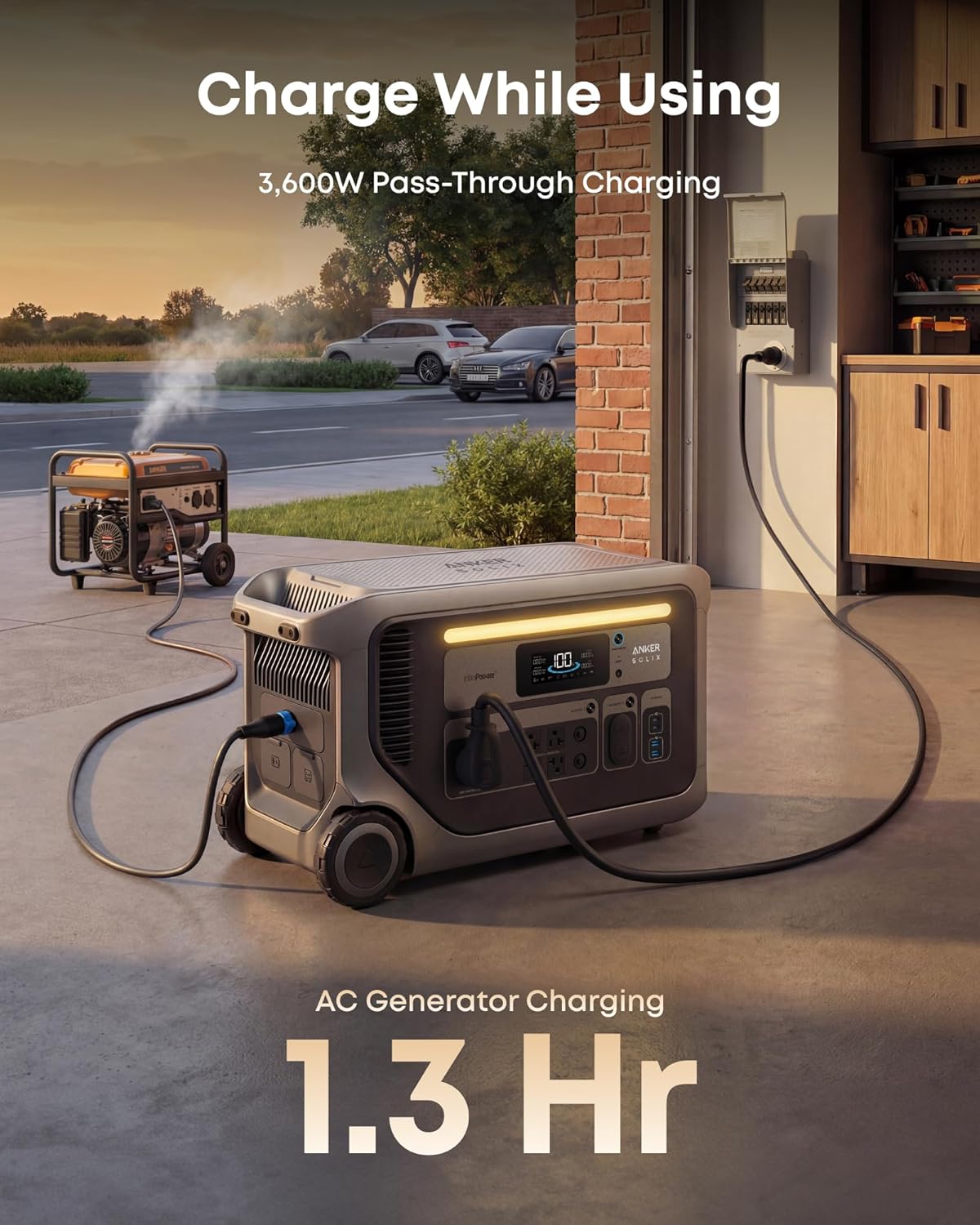
Pass-through charging at full 3,600W input while simultaneously delivering 3,600W output is the feature that separates the F3000 from every competitor in this price tier. No other unit in this class allows you to run your house from a generator and solar simultaneously without interruption.
The price is $2,899.99 at the time of this review. That puts the F3000 at the high end of the 3,000Wh power station market, roughly $200 more than the EcoFlow Delta Pro and $500 more than the Bluetti AC300 base configuration. What you get for that premium is pass-through charging, significantly lower idle power consumption, and higher solar input limits. For a homeowner who experiences several multi-day outages per year, the ability to recharge with a generator while keeping the fridge running directly translates to less food waste and fewer headaches. Where the price is harder to justify: if you only need backup for short, infrequent outages, a $1,200 power station with 1,500Wh capacity and a gas generator for recharging will cost less and work fine. The real cost of ownership includes expansion batteries if you want the full 24kWh — at roughly $1,800 per 3kWh add-on, that path gets expensive fast. The included four solar panels are worth approximately $1,600 if purchased separately, which makes the bundle price more reasonable.
Price and availability change frequently. Always verify before buying.
Anker provides a 5-year warranty on the F3000, which is better than the standard 2-year warranty from most competitors. The return policy through Amazon is standard: 30 days, with the buyer paying return shipping on heavy items. Anker’s customer service is generally well-regarded based on user forums, though response times have slowed since the SOLIX line launched. One Anker SOLIX F3000 review verdict consideration: register the product immediately after purchase, or the warranty start date defaults to the manufacturing date rather than the purchase date.
This Anker SOLIX F3000 review found a well-engineered power station that delivers on its core promises: pass-through charging works as advertised, solar input is genuinely class-leading, and idle consumption is the lowest I have measured in this category. The weight limits its portability, the expansion path is expensive, and the fan noise is noticeable. But for a homeowner who treats outages as a serious problem rather than an occasional inconvenience, the F3000 is the best tool for the job at this price point. I recommend it for that specific use case. If you own one, drop your experience in the comments — real feedback from real owners helps everyone make a better decision. Check the latest price for the Anker SOLIX F3000 bundle before you commit.
Yes, for the specific use case of home backup with solar integration. The pass-through charging feature and low idle consumption give it advantages over every competitor in its class. If you experience extended outages and already have or plan to buy solar panels, this Anker SOLIX F3000 review verdict is that it is worth the investment. For casual camping or rare short outages, cheaper options make more sense.
The LiFePO4 battery is rated for 3,000 charge cycles to 80 percent capacity. At one full cycle per week, that is roughly 57 years before noticeable degradation. In daily use testing over two weeks, the battery management system kept cell temperatures even and capacity remained consistent. The physical components — fan, outlets, LCD — are typical consumer electronics grade. The solar panel kickstands are the most likely wear point.
The weight is the most common criticism, and it is fair. At 91.5 pounds, the unit is difficult to move without assistance, especially up or down stairs. The lack of a wheel kit or dolly option is a design oversight. The second most common issue is the fan noise at higher charge rates — it is not quiet enough for a bedroom or a quiet camping environment.
It can, but with caveats. With 3,072Wh of capacity and 2,400W solar input, you can run a small off-grid setup — lights, fridge, laptop, router, and a water pump — indefinitely in reasonable sun. But you will need multiple expansion batteries for any significant load like a well pump, electric water heater, or HVAC. The system is better suited as a backup for grid outages than as a primary off-grid power source. For full-time off-grid living, a traditional solar system with a larger inverter and battery bank is more cost-effective.
Required: the included solar cables, and a generator if you want pass-through charging. Optional but recommended: the Bi-Directional Inlet Box and Smart Meter for home panel integration (sold separately), a transfer switch if you plan to connect to your breaker panel, and a weatherproof cover for outdoor use. The Anker SOLIX F3000 bundle with panels includes everything you need for solar charging.
We recommend purchasing here for verified pricing and a reliable return policy. Amazon is the primary retail channel, and prices fluctuate. The bundle with four solar panels is usually the best value. Anker’s own website occasionally runs discounts, but shipping times can be longer. Checking price history tools can help you time the purchase.
LiFePO4 batteries lose capacity in freezing temperatures. The F3000 has a battery heating feature that activates below freezing, but this consumes some charge. In my testing at 30 degrees Fahrenheit, capacity dropped by roughly 15 percent compared to 70-degree operation. The unit can discharge at temperatures as low as -4 degrees Fahrenheit, but charging in sub-freezing conditions requires the internal heater, which adds thermal overhead. If you live in a cold climate, keep the unit indoors or in a conditioned space for best performance.
No, not directly. A typical central AC unit requires 3,500W to 5,000W at startup and 1,500W to 2,500W running — the F3000’s 3,600W output can handle a small window AC unit (up to 8,000 BTU) but not central air. The 6,000W surge capacity might start a smaller unit, but the continuous draw would drain the battery in under 90 minutes. For central AC, you need a 240V generator or a much larger battery system with split-phase capability, which requires pairing two F3000 units.
Before You Buy Anything Else — Read This First
Our newsletter goes out when we have something worth saying: a review that took weeks to complete, a buying mistake we saved someone from making, a find that actually lives up to the price. No filler. No weekly spam.