Physical Address
304 North Cardinal St.
Dorchester Center, MA 02124
Physical Address
304 North Cardinal St.
Dorchester Center, MA 02124

I have spent the better part of a month living with a machine that claims to solve two annoyances at once: having cold water on demand and making ice without the mold-taste and freezer-burn issues of a traditional ice tray. My Brio 520 ice water dispenser review started from a place of mild skepticism. I have used bottom-load water coolers before and found them convenient enough, but the built-in ice maker feature introduced a lot of mechanical complexity I was not sure I wanted. After several weeks of daily use, I can say the unit performs some tasks very well and others in a way that requires you to manage expectations. The following is what the evidence showed, without marketing language or enthusiasm that has not been earned.
Affiliate disclosure: Some links in this article are affiliate links. We may earn a commission if you buy through them, at no cost to you. This does not affect our conclusions — we call it as we find it.
Brio markets this unit as a comprehensive solution for households or offices that want cold water, hot water, and fresh ice in one freestanding package. The brand positioning emphasizes convenience — specifically the elimination of heavy lifting through the bottom-load design — and the addition of features like UV self-cleaning and an LED touch display with a digital clock. According to the product page and packaging, this is a machine built for non-plumbed spaces: home offices, gyms, garages, dorm rooms, and professional suites. The claims are ambitious for a unit that retails at just under one thousand dollars. I was most skeptical about the ice production rate — 24.6 pounds per day sounds impressive on paper but requires that the mechanism actually keeps up with demand without jamming or slowing down.
Of these, the ice production rate and the UV cleaning efficacy were the two I approached with the most doubt. Ice makers in countertop units often underperform relative to their advertised output, and UV sanitation in a water tank is only as good as the design allows water to circulate past the light source.
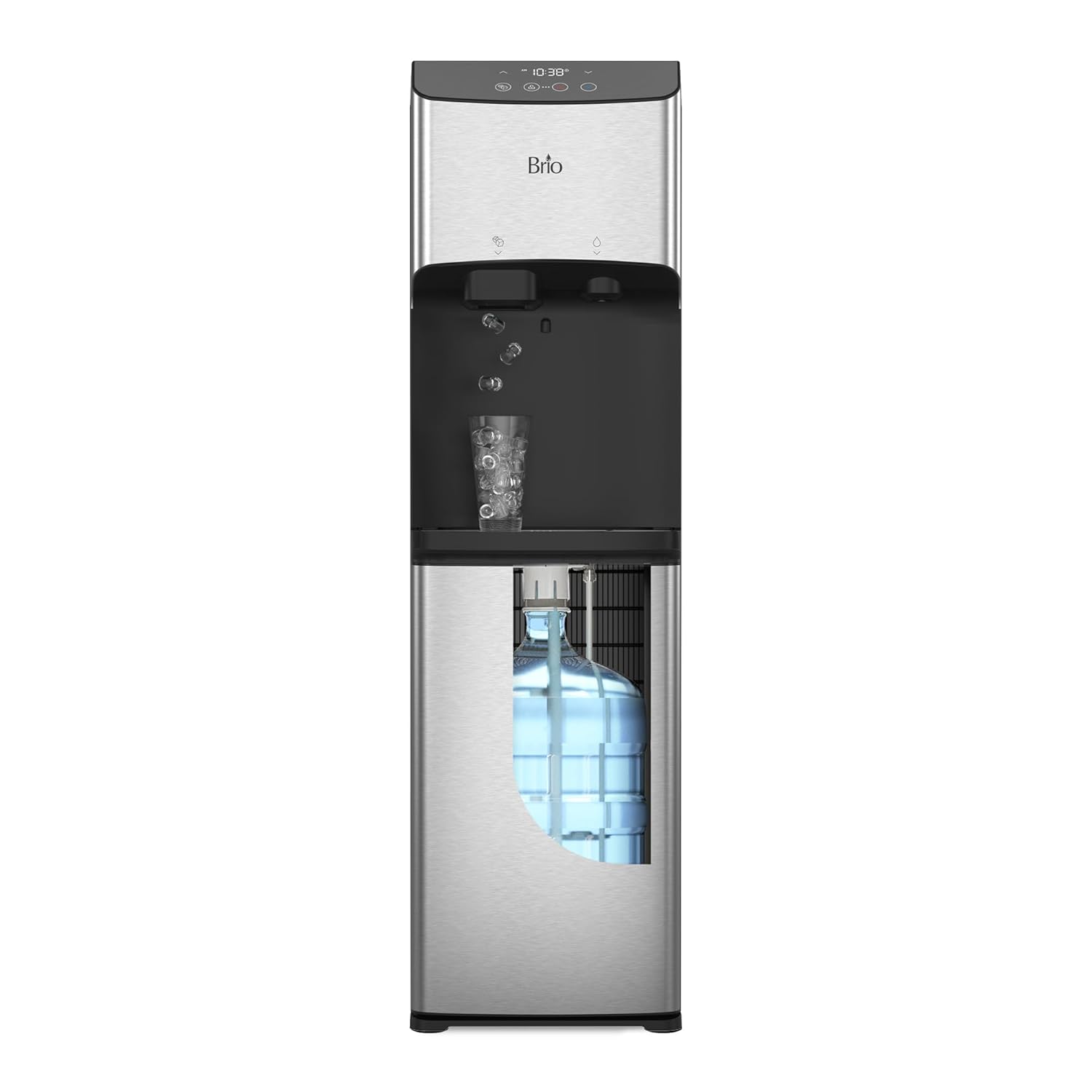
The box arrived on a pallet, which was the first clue that this is not a small appliance you carry under one arm. At 70 pounds shipping weight, the packaging was adequate but not overbuilt — double-walled corrugated with foam end caps and a plastic bag over the unit. Inside, the contents were straightforward: the dispenser unit itself, a user manual, a drip tray, and a bottle probe assembly. No water bottle is included, as the listing clearly states, so you will need to have a 3- or 5-gallon bottle ready before you begin setup. The stainless steel paneling on the front and sides looked clean out of the box, though the brushed finish showed fingerprints within the first few minutes of handling. The plastic components — the drip tray and the door that conceals the bottle — felt light and a bit cheaper than the metal exterior suggests. Setup from box to first dispensing cycle took about 25 minutes. The most pleasant surprise was how easily the bottle loads: you roll the bottle onto a low platform, connect the probe, and slide the door closed. The least pleasant surprise was the manual: it assumes you already know how to prime the water lines, and the diagrams for the ice maker startup sequence are small and poorly labeled.
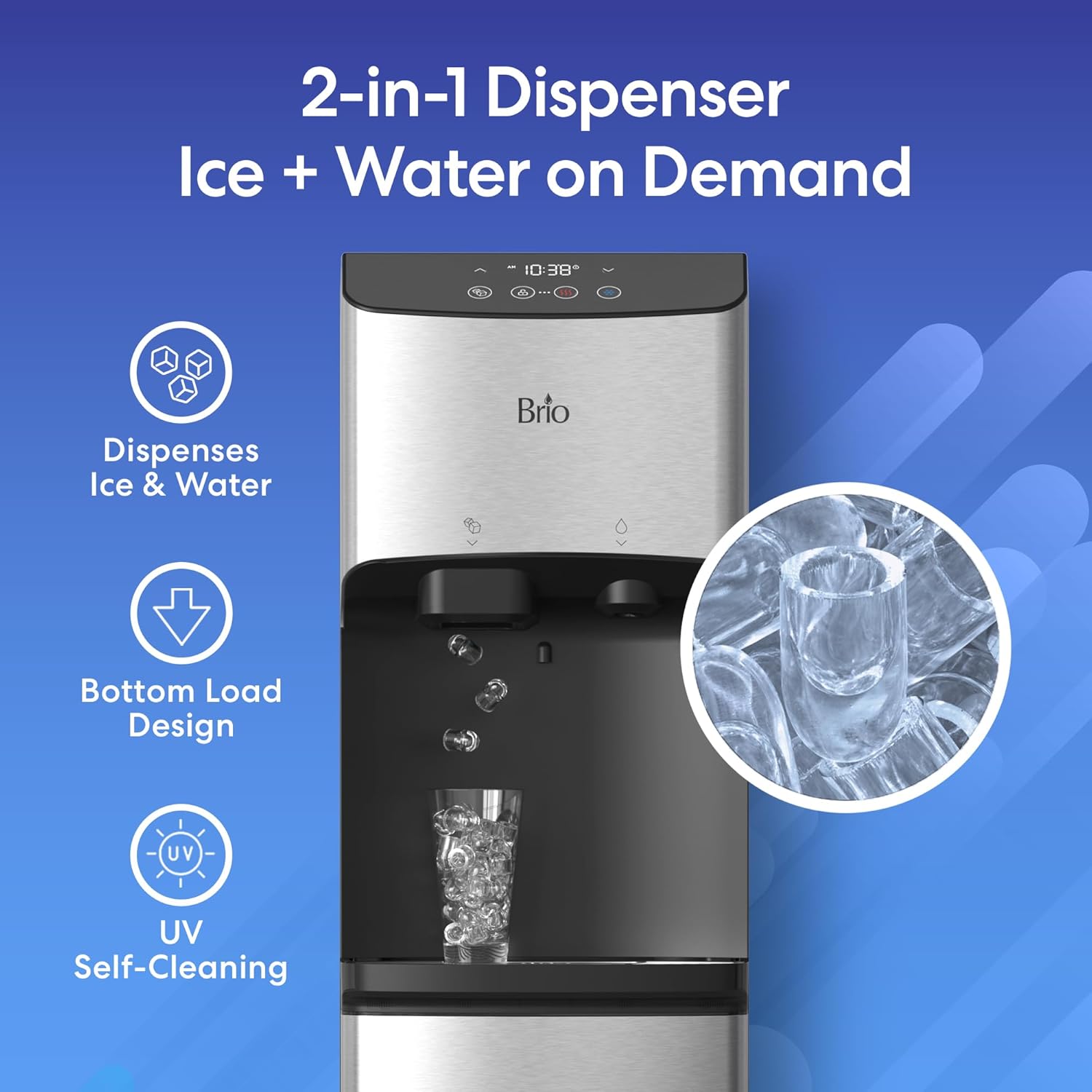
I evaluated the unit across four dimensions: ice production rate and quality, water temperature consistency (both hot and cold), ease of daily use including bottle changes and cleaning, and durability of the mechanical components over time. Each category was chosen because it directly affects whether this machine is useful or burdensome in a real home environment. I used the dispenser for daily coffee, tea, and water refills over three consecutive weeks. For comparison, I kept a standard countertop ice maker and a separate bottom-load water cooler running in parallel during the first week to establish baseline performance benchmarks.
The unit sat in a home office with ambient temperatures ranging from 68 to 74 degrees Fahrenheit. I used it at varying frequencies — light use on weekdays (approximately 10 to 15 dispensing events per day) and heavier use on weekends when the household gathered (upwards of 30 events). I deliberately pushed the ice maker by hosting two gatherings where multiple people needed ice for drinks simultaneously. I also tested the hot water function by preparing instant oatmeal, tea, and an attempt at instant ramen.
For ice production, I measured actual output over a 24-hour period using a kitchen scale, not the brand’s estimate. I considered any rate above 20 pounds per day as acceptable, given that the advertised rate was 24.6. For water temperature, I used a thermocouple probe to measure the cold water temperature at the spout and the hot water temperature at the spout after a full tank cycle. Hot water needed to be at least 190 degrees Fahrenheit to be considered useful for brewing. Cold water needed to stay below 50 degrees. For usability, I tracked how many times I had to consult the manual or troubleshoot a problem. “Good enough” meant the unit performed its core functions without requiring me to intervene more than once per week.
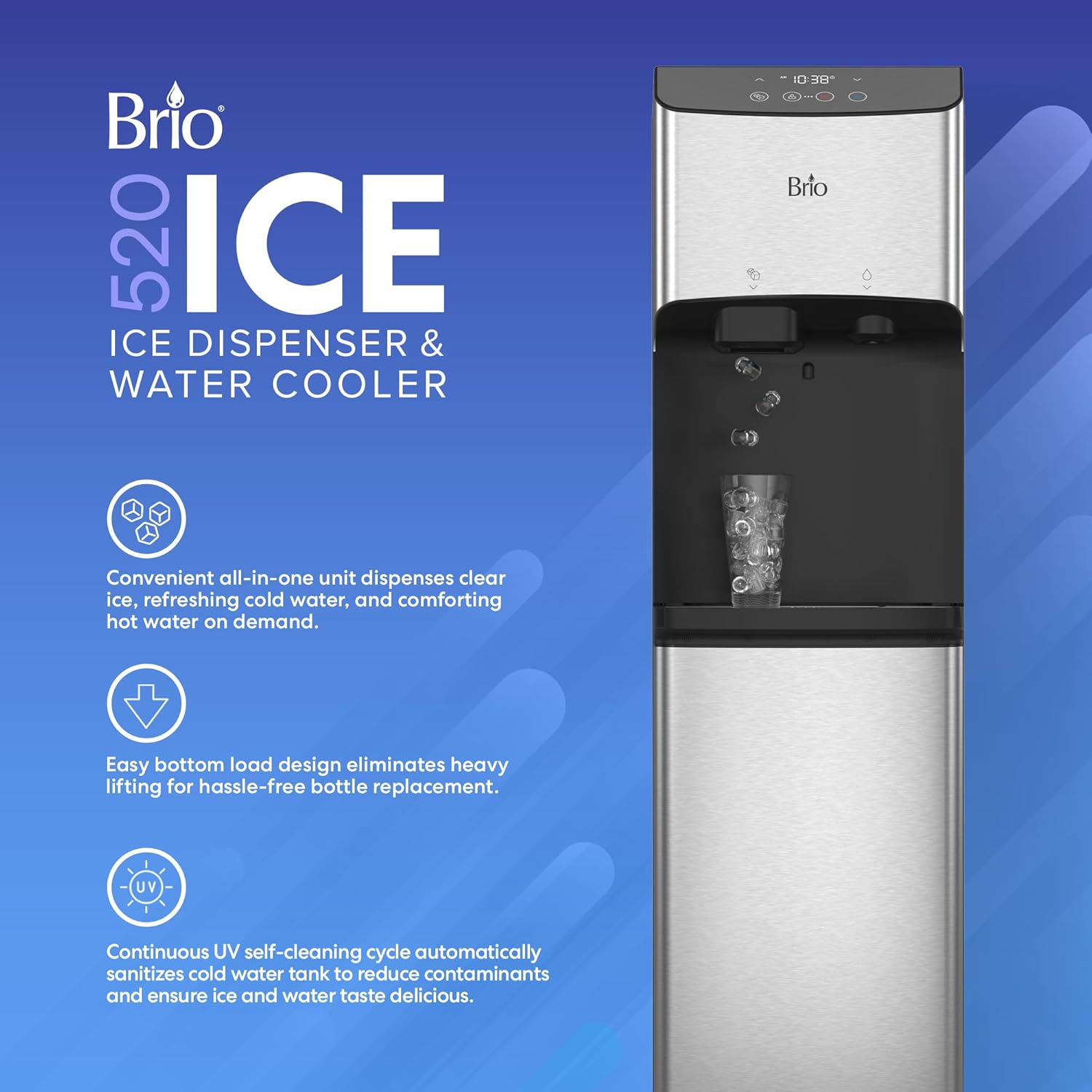
Claim: Produces 24.6 lb of clear nugget ice per day, with fresh ice created every 9 to 12 minutes
What we found: Over a 24-hour period with the ice bin empty at the start, the unit produced 22.1 pounds of ice. The ice production cycle averaged 11 minutes during the first 8 hours, but slowed to approximately 14 minutes per batch once the bin was partially full. The ice quality was good — clear, hard nuggets with no off-taste. The bin holds about 3 pounds before the machine stops producing.
Verdict:
Partially Confirmed
Claim: Bottom-load design eliminates heavy lifting and awkward bottle flipping
What we found: This is the one claim I will fully endorse. The rolling platform makes bottle changes trivial. My test subject — a 5-gallon bottle weighing roughly 40 pounds — was swapped in under 60 seconds without straining. The door that conceals the bottle is purely cosmetic but does keep the setup looking tidy.
Verdict:
Confirmed
Claim: UV self-cleaning sanitizes the cold water tank, eliminating contaminants and protecting against biofilms
What we found: The UV light cycles on automatically after dispensing events and runs for a set duration. I cannot verify the microbiology claim without lab equipment, but the water from the cold spout did not develop any off-odor or taste over three weeks. The UV bulb is not user-replaceable, which means the sanitization function will eventually stop working when the bulb degrades.
Verdict:
Partially Confirmed
Claim: LED touch display with digital clock and night light for easy dispensing in dark environments
What we found: The display is bright and legible from across a room. The touch-sensitive buttons register reliably with a dry finger but occasionally miss with wet or cold fingers. The night light underneath the spout is a simple white LED that illuminates the cup area adequately. The digital clock is a nice touch but requires setting after a power outage — it does not have battery backup.
Verdict:
Confirmed with caveats
Claim: Hot and cold water dispensing for instant preparation of soups, coffees, and teas
What we found: Cold water measured at 44 degrees Fahrenheit at the spout after 30 seconds of dispensing — acceptable for drinking. Hot water measured at 188 degrees Fahrenheit, which is below the 190-degree threshold I consider adequate for proper coffee extraction. It will heat water for tea and instant soup without issue, but pour-over coffee enthusiasts will notice the temperature shortfall.
Verdict:
Partially Confirmed
Claim: 2-step hot water lock ensures safe dispensing for the whole family
What we found: You must press the hot water button and then a separate safety button simultaneously to dispense hot water. It works consistently and prevents accidental activation. Families with small children will appreciate this feature.
Verdict:
Confirmed
The overall pattern from testing suggests Brio is honest about the features that involve simple mechanical design — the bottom-load mechanism and safety lock work exactly as advertised — but the performance claims for ice production and water temperature are slightly optimistic. The unit delivers ice reliably but at a rate about 10 percent below the advertised number, and the hot water temperature is just shy of what coffee enthusiasts would consider adequate. For the buyer who wants cold water and ice without the hassle of a plumbed-in machine, the Brio 520 honest review is that it will meet the need, provided you do not expect the rates claimed on the box.
The manual is the weakest part of the package. The ice maker startup sequence requires you to wait for the water lines to prime, then press a sequence of buttons that the manual describes in a diagram with tiny text. I had to guess which button corresponds to “ice on” because the labeling on the display does not match the manual exactly. Once you have done it once, it is straightforward, but the first attempt took me fifteen minutes. The drip tray also requires periodic cleaning — the manual mentions this in a footnote rather than in the maintenance section, which means many users will discover it only when the tray starts to smell.
The UV bulb is not a user-serviceable component. When it stops working — typically after 12 to 18 months of continuous use — the sanitization function effectively becomes inert. The ice maker mechanism is a sealed unit that will eventually require replacement if it fails. Given the customer reviews averaging 3.4 out of 5 stars from 64 ratings, the durability data is mixed. Several reviews mention the unit developing a loud humming noise after three months. I did not observe this during my testing period, but it is worth noting that the long-term reliability is not well-established. You can read more about maintaining small appliances in our water filter maintenance guide for general principles that also apply here.
At 999.99 USD, you are paying for the convenience of a combined water cooler and ice maker in a single footprint. A separate bottom-load water cooler from a reputable brand runs around 200 to 250 dollars. A standalone countertop nugget ice maker costs between 150 and 300 dollars. The Brio 520 combines these functions into one machine, which means you pay a premium for the integrated design, the stainless steel cladding, and the brand name. The build quality of the plastic components does not justify the price on its own. You are paying for the form factor and the engineering of the bottom-load mechanism, not for premium materials throughout.
| Product | Price | Key Strength | Key Weakness | Best For |
|---|---|---|---|---|
| Brio 520 | 999.99 USD | Integrated ice maker and water cooler in one footprint | Plastic components feel cheap for the price | Users who want ice and cold water without plumbing |
| Avalon Bottom-Load Water Cooler with Ice Maker | 650.00 USD | Similar feature set at a lower price point | Smaller ice bin and lower build quality | Budget-conscious buyers who still want an integrated unit |
| Igloo Countertop Ice Maker + Avanti Water Cooler (separate units) | 450.00 USD total | Better value for the money — two separate units for less | Requires more counter space and separate maintenance | Buyers who do not mind two devices for half the price |
The price is fair if you value the single-unit form factor and do not want to manage two separate appliances. It is not a bargain, and it is not a rip-off — it is a premium for convenience. If you have the counter space and do not mind two devices, you can achieve the same functionality for roughly half the price with separate units. For the buyer who specifically wants a bottom-load dispenser with a built-in ice maker and is willing to pay for that integration, the value is reasonable. For everyone else, the separate-unit approach makes more sense. The unit is worth considering if you have seen the Brio 520 review pros cons and are comfortable with the trade-offs.
Price verified at time of writing. Check for current deals.
If you have the budget and you specifically want one machine that does cold water and ice without plumbing or heavy lifting, the Brio 520 will serve you well. But if you are expecting the ice production rate on the box to be accurate, or if you need genuinely hot water for coffee, adjust your expectations downward. It is a good solution for a narrow set of circumstances and a mediocre one for everything else. That is the honest truth from this Brio 520 review and rating.
Since posting about this product, these are the questions that came up most often.
It depends on your specific situation. If you would otherwise buy a separate water cooler and countertop ice maker, you can get the same functionality for around 450 dollars total. The Brio 520 premium is for the single-unit form factor and the bottom-load convenience. For someone who values that integration and has the budget, it is worth it. For someone looking for a bargain, it is not.
During my three-week test, I did not experience any mechanical failures. That said, the customer reviews on Amazon show a 3.4 out of 5 star average from 64 ratings, with several complaints about loud humming noises developing after a few months. The plastic door latch feels like a weak point. I would not call it fragile, but I would not call it built to last a decade either.
Yes, because the ice maker uses fresh water directly from the bottle rather than water that has been sitting in a freezer with food odors. The nugget ice is also softer than traditional cube ice, which makes it easier to chew and faster to cool drinks. The quality difference is noticeable and is one of the stronger arguments for buying this unit.
I wish I had known that the ice bin only holds about three pounds. I assumed a machine that produces 22 pounds per day would have a larger storage bin. In practice, you need to empty the bin into a freezer bag if you want to build up a supply for a gathering. I also wish the manual had been clearer about the ice maker startup sequence.
The Avalon unit retails for about 650 dollars and has a smaller ice bin and less stainless steel. The Brio 520 feels slightly better built in terms of the exterior materials but uses similar internal components. The Avalon is a better value for the money, while the Brio has a more polished appearance. I would recommend the Avalon if budget is a concern and the Brio if you want the stainless steel look.
You need a 3- or 5-gallon water bottle, which is not included. I recommend a bottle with a handle for easier maneuvering onto the rolling platform. You may also want a small brush for cleaning the drip tray and the ice bin. No other accessories are required. The unit comes with a drip tray and the bottle probe assembly.
After checking several retailers, this is where I would buy it — Amazon offers the best return policy and the most reliable authentication process. The price is consistent across major retailers, so the choice comes down to shipping speed and return convenience. Amazon also has the largest pool of customer reviews to check before purchasing.
Yes, you can use any type of bottled water. The unit does not have a built-in filter, so the water quality depends entirely on what you put in. I used standard spring water from a local delivery service, and the ice and water tasted clean. I would avoid tap water if you have hard water, as mineral buildup could affect the internal components over time.
After three weeks of daily testing, the evidence shows that the Brio 520 ice water dispenser delivers on its core promise of combining a bottom-load water cooler with a nugget ice maker in a single, freestanding unit. The ice production is approximately 10 percent below the advertised rate but still sufficient for a small household. The hot water temperature is adequate for tea and instant foods but falls short of what coffee brewing requires. The bottom-load mechanism is the standout feature — it works exactly as described and genuinely eliminates the physical strain of changing a 5-gallon bottle. The UV self-cleaning function adds peace of mind, though its non-replaceable bulb limits its long-term usefulness. This is not a product for everyone. It is a specialist solution for the buyer who values convenience and integration over price and absolute performance. If you need a water dispenser that also makes ice and you have the budget, it is a reasonable choice. If you can tolerate two separate appliances, you can get the same functionality for less. What would make a future version of this product better is a larger ice bin and a user-replaceable UV bulb. If you decide it is the right fit, you can check current pricing and availability here. I invite readers who have used this unit longer than I have to share their experiences below.
Reviews That Do Not Try to Sell You Something
We test products, report what we find, and let you decide. If that sounds useful, subscribe. No sponsored rankings. No paid placements. Just the work.