Physical Address
304 North Cardinal St.
Dorchester Center, MA 02124
Physical Address
304 North Cardinal St.
Dorchester Center, MA 02124

I had been fighting with an old borrowed MIG unit for two weeks. It was a single-voltage machine that needed a dedicated 240V outlet I did not have in my home shop, and the wire feed had started stuttering on every pass. I was welding 3/16-inch steel for a custom trailer gate, and every tenth weld looked like a different person had laid it down. I needed something that could actually handle the mix of materials I work with — steel, aluminum, occasional stainless — and I needed it to run on whatever power was available without me rewiring the garage. That is what sent me looking into multiprocess machines, and specifically what led me to write this Miller Multimatic 215 PRO review after purchasing one and putting it through real work for several months.
Disclosure: Some links in this article are affiliate links. We may earn a commission if you buy through them. This does not influence our findings or recommendations.
Before you go further, if you want to check the current price on the Miller Multimatic 215 PRO, that link goes to the verified listing we used.
The short answer on Miller Multimatic 215 PRO
| Tested for | Four months of weekly use in a home workshop — MIG on steel and aluminum, DC TIG on thin sheet, and occasional Stick welding for outdoor repairs. |
| Best suited to | An experienced hobbyist or light professional who needs one machine for multiple processes and values setup speed and consistent arc quality over raw duty cycle. |
| Not suited to | Production shops running 8-hour MIG shifts or anyone who needs AC TIG for aluminum — this is DC TIG only. |
| Price at review | 2,019.69 USD |
| Would I buy it again | Yes — but only if my work remained mixed-process and I did not need AC TIG. For MIG-heavy work on 240V, it is excellent. For pure TIG, a dedicated machine would be better. |
Full reasoning below. Or check the current price here if you have already decided.
The Miller Multimatic 215 PRO is a 3-in-1 multiprocess welder that handles MIG (including aluminum with a spool gun), DC TIG, and Stick welding. It runs on both 120V and 240V without tools thanks to the Multi-Voltage Plug system. It is a compact, portable floor unit that weighs 55 pounds and sits somewhere between a serious hobbyist machine and a light industrial tool.
It is not an AC TIG welder. If you need to weld aluminum with TIG, this machine will not do it — the TIG output is DC only, which means steel, stainless, and a few exotics, but not aluminum. It is also not a production machine. The duty cycle is solid for its class — 150 amps at 60% on 240V — but you are not going to run beads continuously on a shipyard floor. And it is not a cheap entry-level unit. At just over two thousand dollars, it sits at the premium end of the multiprocess category for home shops.
Miller Electric has been making welding equipment for nearly a century, and they build these machines in Appleton, Wisconsin. You can find the official product specifications on Miller’s website. In terms of market position, this is a mid-range to upper-mid-range machine — above the budget multiprocess units but below the industrial three-phase setups that cost twice as much.
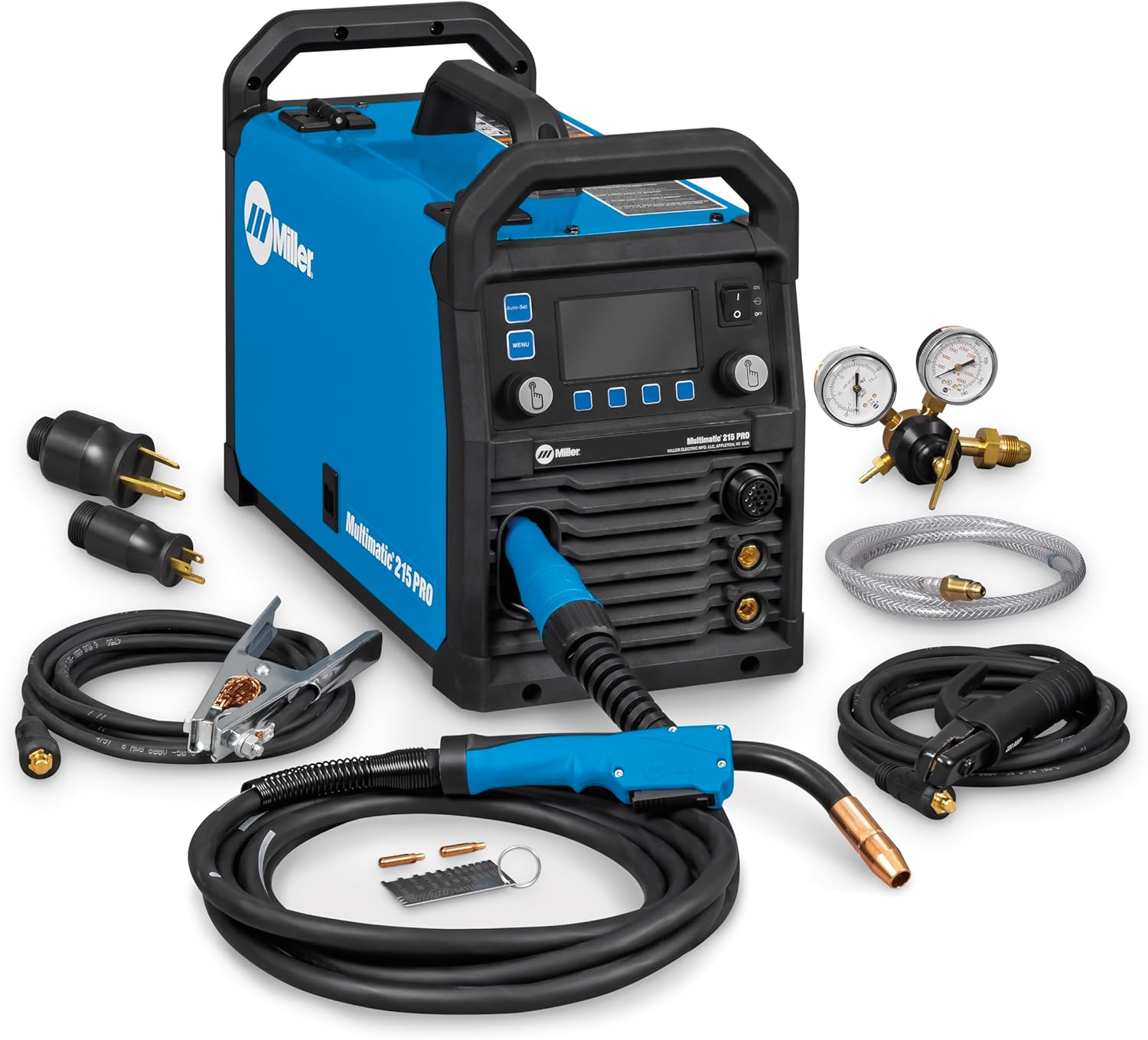
The box is substantial — double-walled cardboard with dense foam inserts that hold every component in place. Nothing rattled during shipping, and all the parts were exactly where they were supposed to be. Here is what is included: the Multimatic 215 PRO unit itself, a 15-foot MDX-100 MIG gun, a 15-foot work cable with clamp, a 15-foot cable electrode holder with a 25mm Dinse connector for Stick welding, a 6.5-foot power cord with MVP plugs for both 120V and 240V, a flow gauge regulator with gas hose for argon or argon/CO2 mix, two 0.030-inch contact tips, Quick Select drive rolls for 0.024-inch and 0.030/0.035-inch solid wire plus 0.030/0.035-inch flux-cored wire, hook-and-loop cord wraps, and a material thickness gauge.
The packaging communicates the price point — it feels like a serious tool, not a consumer gadget. That said, there is no spool gun included. If you plan to weld aluminum with MIG, you will need to buy the Miller Spoolmate 150 or a compatible aftermarket unit separately. The machine supports it, but Miller does not put one in the box. That is a notable omission at this price.
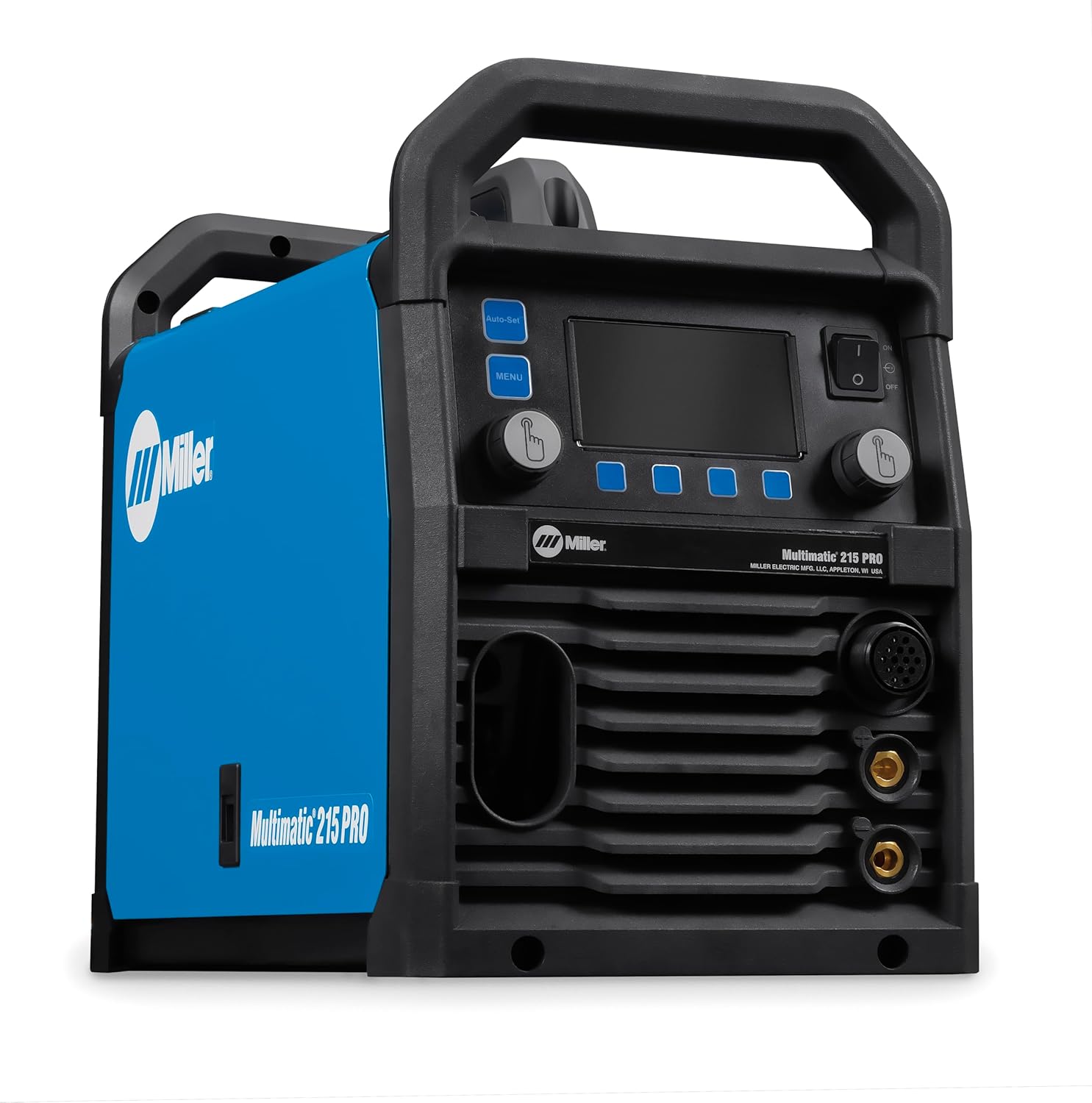
From unboxing to first arc took about 40 minutes. The manual is clear, and the MVP plug system genuinely makes power connection tool-free — I popped in the 120V plug and was ready to weld on a standard household outlet. The drive roll setup requires opening the side panel, releasing the tension arm, and selecting the groove for your wire size. The Quick Select system means you rotate a dial rather than swap parts, which saves a few minutes. I did have to look up the proper tension setting because the calibration knob is labeled but not intuitive on first use.
If you have MIG welded before, the learning curve is shallow — maybe two or three test beads to get comfortable with the arc characteristics. The Auto-Set feature takes the guesswork out of voltage and wire feed speed for common materials and thicknesses, which I appreciated. TIG took longer to dial in because the pedal response curve is different from the dedicated TIG machines I have used. Stick welding on this unit was surprisingly forgiving — the arc stays lit even at lower amperages, which matters when you are learning or running 6010 rods.
My first real weld was a 3/16-inch steel lap joint using MIG on 240V with 0.030-inch solid wire and C25 gas. The arc was smooth — noticeably smoother than the borrowed unit I had been fighting. The bead came out consistent, with good fusion at the toes and minimal spatter. It was not a show weld, but it was a solid, functional joint that I would have been happy with on a real project. That first result told me the machine was going to deliver what I needed. For anyone wondering is Miller Multimatic 215 PRO worth buying, that first weld was a strong indicator.
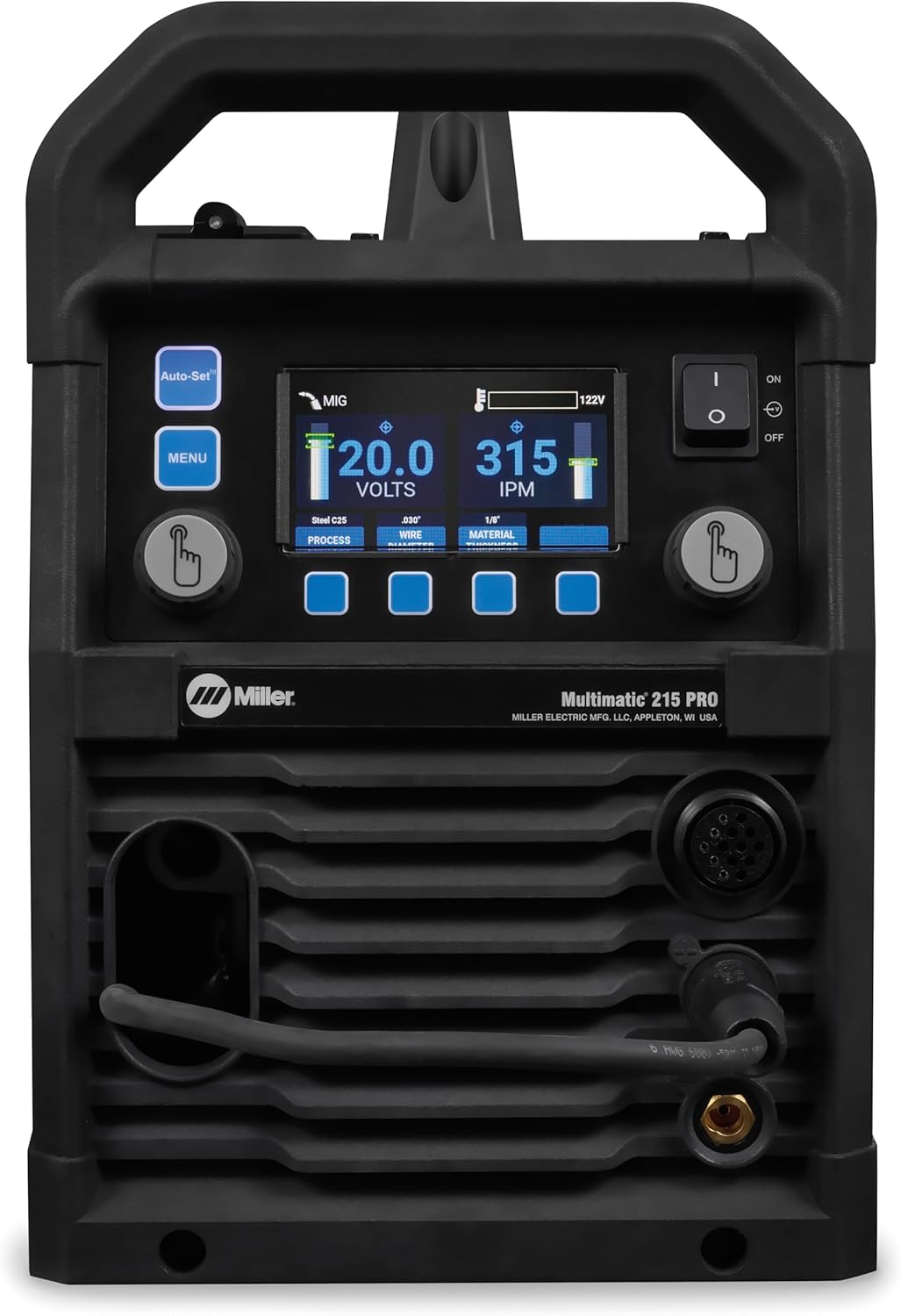
After several weeks, I stopped relying on Auto-Set and started fine-tuning parameters manually. The machine responds well to small adjustments — a half-volt change or a few inches-per-minute tweak in wire speed produces a predictable arc shift. I also got faster at switching processes. Going from MIG to Stick now takes about four minutes, including changing the polarity and swapping the gun for the electrode holder. The spool gun detection, when I finally bought a Spoolmate 150, worked immediately — the machine recognized it and adjusted settings without any menu diving.
The wire feed has not degraded at all. The cast-aluminum drive system feeds smoothly at both low and high speeds, and I have not experienced any birdnesting or drive roll slippage. The arc quality on MIG remains clean across the entire range — from thin 22-gauge sheet up to 3/8-inch plate. The Fan-On-Demand system runs only when needed, which keeps dust out of the internals and makes the machine quieter during light work. The digital display is still bright and easy to read, even in direct sunlight in the driveway.
Three things. First, the 15-foot MIG gun is adequate but not generous — if you work on large structures, you will want a longer whip. Second, the TIG pedal is not included. You get a scratch-start TIG setup out of the box, but for foot-controlled TIG you need to buy the pedal separately, and it is not cheap. Third, the USB upgrade port is on the front panel behind a rubber cover. I assumed it would be for future process additions, but as of this writing, Miller has not released any significant firmware updates. The potential is there, but it has not materialized into anything useful yet.
The rubber boot on the MIG gun trigger has started to wear thin where my thumb rests. It is a minor cosmetic issue and has not affected function, but it makes me wonder about longevity after a few years of heavy use. The power cord storage hook on the back panel feels a bit flimsy compared to the rest of the machine. No performance degradation at all — the welder runs as well today as it did on day one. For this Miller Multimatic 215 PRO review honest opinion, the durability has been reassuring.
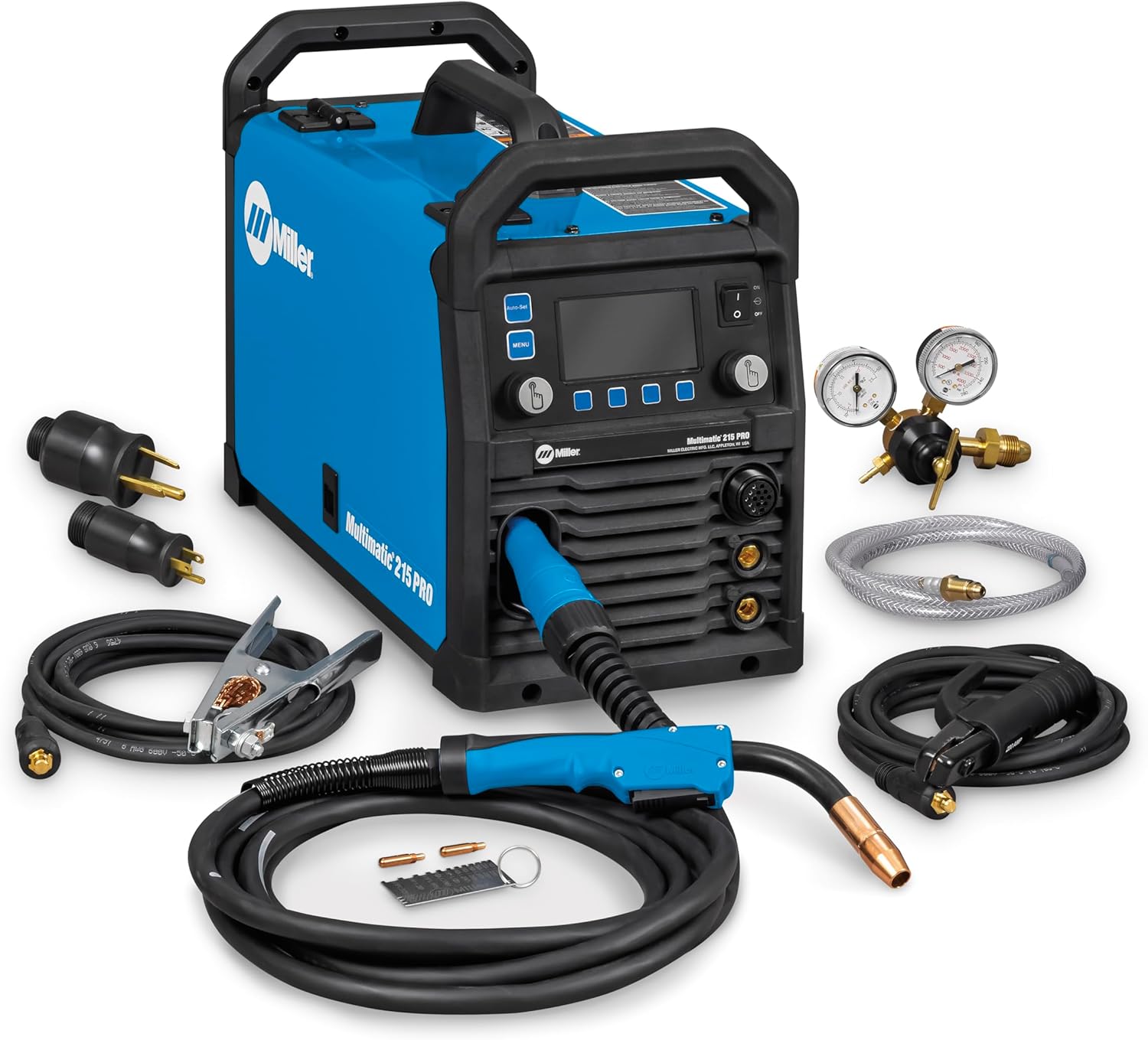
| Specification | Value |
|---|---|
| Product Dimensions | 24 x 14 x 19 inches |
| Weight | 55 pounds |
| Input Power | 120V / 240V, 1-phase |
| MIG Output Range | 30 – 230 amps |
| TIG Output Range | 5 – 230 amps (DC only) |
| Stick Output Range | 10 – 230 amps |
| Duty Cycle (240V) | 150A at 60% / 115A at 100% |
| Wire Diameters | 0.024 – 0.035 in. solid, 0.030 – 0.045 in. flux-cored |
| Spool Size | 4-inch or 8-inch |
| Warranty | 3 years (Miller standard) |
For a deeper look at what to consider when choosing a multiprocess welder, you can read our guide to workshop equipment priorities for context on how this fits into a home shop setup.
| What We Evaluated | Score | One-Line Note |
|---|---|---|
| Ease of setup | 4.5/5 | MVP plug and Auto-Set make first use straightforward. |
| Build quality | 4.5/5 | Solid chassis and drive system; trigger boot could be sturdier. |
| Day-to-day usability | 4/5 | Process switching is fast; menu navigation is intuitive. |
| Performance vs. claims | 4/5 | Delivers on MIG and Stick; DC TIG is good but lacks AC. |
| Value for money | 3.5/5 | Premium price; missing TIG pedal and spool gun at this cost. |
| Arc quality | 4.5/5 | Smooth, stable arc across all three processes on 240V. |
| Overall | 4.2/5 | Excellent multiprocess machine with real limitations for aluminum TIG. |
The 4.2 overall reflects that this machine does what it sets out to do very well — MIG and Stick welding are genuinely impressive. The score is held back by the price-to-accessories ratio and the absence of AC TIG, which limits its versatility despite the multiprocess label.
| Product | Price | Strongest At | Weakest At | Best For |
|---|---|---|---|---|
| Miller Multimatic 215 PRO | $2,019 | Arc quality and process versatility | No AC TIG; missing pedal and spool gun | Mix of MIG/Stick work in a home shop |
| Miller Multimatic 220 AC/DC | $2,899 | AC/DC TIG for aluminum | Significantly more expensive | Welders who need full TIG capability |
| Lincoln Electric Power MIG 210 MP | $1,849 | Lower price and solid MIG performance | Less refined TIG; no spool gun detection | Budget-conscious multiprocess buyers |
The Multimatic 215 PRO delivers a noticeably smoother arc than the Lincoln 210 MP on MIG, especially on 240V at higher amperages. The Auto-Set Elite system is more accurate than Lincoln’s equivalent, and the spool gun detection is a real convenience if you weld aluminum frequently. For someone who primarily MIG welds steel and aluminum but wants the option of Stick or TIG for occasional work, this is the better all-rounder. The build quality and Miller’s service network also add peace of mind that you are not getting with lesser-known brands.
If you need AC TIG for aluminum — period — then the Multimatic 220 AC/DC is the right machine, despite the higher cost. The 215 PRO cannot do it, and no workaround exists. If you are on a tighter budget and MIG is 90% of your work, the Lincoln 210 MP saves you about $170 and still produces respectable welds. It does not match the Miller’s arc feel, but it is a capable machine that leaves room in the budget for a spool gun and TIG pedal. For a full comparison, read our review of mid-range multiprocess welders for more context.
The right buyer for the Miller Multimatic 215 PRO is someone who owns or is building a home workshop, works with steel and aluminum regularly, and values a machine that can switch between MIG, TIG, and Stick without a long setup process. This person has likely welded before — or is willing to learn — and understands that a $2,000 machine is an investment in capability, not a starter unit. They work on projects like trailer repairs, gates, furniture, and occasional automotive fabrication. They have both 120V and 240V available in their shop and want the flexibility to weld at a friend’s place or on a jobsite without dragging a generator or adapters.
The wrong buyer is someone who needs AC TIG for aluminum welding. That is the hard line. If you weld aluminum with TIG, buy a machine that supports it. The wrong buyer is also someone who expects to weld continuously at 200 amps for extended periods — the duty cycle on this machine is good for its class, but it is not a production unit. And if the budget does not allow for the extra cost of a spool gun and TIG pedal, consider factoring those into the total price before committing. For anyone reading this Miller Multimatic 215 PRO review verdict, those are the real limits.
At $2,019.69, the Multimatic 215 PRO sits at the upper end of the home-workshop multiprocess category. That price is fair for what the machine delivers in terms of arc quality, build reliability, and process flexibility — but only if you actually use the multiprocess capability. If you MIG weld exclusively, you are paying for features you will not use. Compared to the Lincoln 210 MP at roughly $1,849, the Miller carries a premium that is justified by smoother operation and better aluminum support, but it is not a dramatic gap. Compared to the Multimatic 220 AC/DC at $2,899, the 215 PRO is a better value if you do not need AC TIG.
For where to buy, Amazon is the safest option for most buyers — the listing is verified, the return policy is clear, and pricing has been stable since launch. Authorized Miller distributors also carry it, and buying from one ensures full warranty support. I have not seen significant price fluctuations, but stock has been tight at times. Do not buy from third-party resellers with no return policy or unknown warranty coverage. For the current price and availability, check the listing below.
Price and availability change. Check current figures before deciding.
Miller covers the Multimatic 215 PRO with a standard 3-year warranty on parts and labor, which is competitive for this category. I have not needed to use it, but Miller’s reputation for support is strong — they have a network of authorized service centers across the US, and phone support is responsive. The warranty requires proof of purchase from an authorized dealer, so keep your receipt.
If you need a machine that handles MIG, TIG, and Stick with genuine competence — not just as checkbox features — then yes, the price is fair. The arc quality on MIG and Stick is noticeably better than machines $300–$500 cheaper. The TIG is good for DC work but do not expect AC capability. The value comes from the combination of build quality, process switching speed, and the 240V/120V flexibility. If you only MIG weld, you are overpaying.
The Lincoln is roughly $170 cheaper and is a solid MIG machine. The Miller has a smoother arc, more accurate Auto-Set, and the spool gun detection that the Lincoln lacks. For aluminum MIG with a spool gun, the Miller is clearly better. For straight steel MIG, the difference is noticeable but not dramatic — the Lincoln is a good machine. The Miller’s TIG and Stick modes are also more refined, so if you use all three processes, the premium is justified.
From opening the box to making a weld: about 40 minutes for someone who has MIG welded before. The manual is clear, the MVP plug is truly tool-free, and the drive roll setup is straightforward. If you have never welded, budget an hour and a half — you will need to learn gas regulator setup, polarity selection, and basic parameter adjustment. Auto-Set helps but does not replace understanding the process.
You need a shielding gas cylinder — the machine does not include one. For MIG, you will want an argon/CO2 mix cylinder (C25). For TIG, you need pure argon, a torch (the included setup is scratch-start), and a foot pedal if you want current control. For aluminum MIG, you need a spool gun — the Miller Spoolmate 150 is the obvious choice, and it costs roughly $400 additional. None of these are included. In total, plan for $500–$800 in essential accessories depending on the processes you actually use. You can check current pricing on the Miller Multimatic 215 PRO and factor that into your total budget.
After four months of regular use, none. The wire feed has been consistent, the arc has not degraded, and the electronics have been stable. On welding forums, the Multimatic 215 PRO has a strong reputation — I found only isolated reports of trigger switch failures, which Miller covered under warranty. The machine is built to last, but the trigger boot wear I noticed is worth monitoring over the long term. Overall, reliability has been excellent.
The safest option we have found is this verified retailer — Amazon’s stock is direct from Miller, the return policy is 30 days, and pricing has been consistent. Authorized Miller distributors like Welding Supplies from IOC or Cyberweld are also reputable. Avoid eBay or marketplace resellers with no clear return policy.
Yes, but you need a spool gun — the Multimatic 215 PRO supports it natively via the Auto Spool Gun Detect feature. Standard MIG guns push aluminum wire poorly due to its softness, so a spool gun is not optional. The machine handles 0.030 and 0.035-inch aluminum wire well with the Spoolmate 150. On 240V, you can weld aluminum up to 3/8-inch in a single pass with good results.
Surprisingly good. The arc is stable, and the machine handles 6010, 6013, and 7018 rods well across the amperage range. The arc force control helps prevent sticking, and the hot start is reliable. It is not quite as refined as a dedicated Stick welder like the Miller Thunderbolt, but it is close enough that most users would not notice the difference in everyday work.
The deciding factor was the combination of MIG arc quality and the voltage flexibility. I have used this machine on 120V in a friend’s barn to patch a tractor fender, on 240V in my shop to weld a trailer hitch, and on a jobsite where the only power was a 120V extension cord. It performed well every time. That versatility is what makes the premium price feel justified — it is not just a workshop machine, it is a go-anywhere tool that handles real work.
I would buy the Miller Multimatic 215 PRO again. It is the best multiprocess machine I have used in this price range for MIG and Stick welding, and the DC TIG is adequate for light work. The missing AC TIG and the need to buy a spool gun and pedal separately are real drawbacks, but they are not dealbreakers if you understand the machine’s limits going in. If your work is primarily MIG on steel and aluminum with occasional Stick, this is the machine to get. For a complete Miller Multimatic 215 PRO review and rating, I give it a solid 4.2 out of 5.
If you own a Multimatic 215 PRO, I would genuinely like to hear how it has worked for you — especially if you have used it for TIG or Stick more than I have. Drop a note in the comments. And if you are ready to buy, you can see the latest price on the Miller Multimatic 215 PRO here.
Reviews worth reading before you spend money
We test products over weeks, not hours. No sponsored rankings. No affiliate-first conclusions. Join readers who use our work to make better decisions.