Physical Address
304 North Cardinal St.
Dorchester Center, MA 02124
Physical Address
304 North Cardinal St.
Dorchester Center, MA 02124

I started looking into whole house fans after a particularly miserable August. My central AC was running 16 hours a day, my electric bill had climbed 40 percent over the previous year, and the house still felt stuffy by mid-afternoon. A neighbor with a similar 1960s ranch house mentioned he had cut his cooling costs by half with a whole house fan. I was skeptical. I had read the marketing claims: “Feel 10 degrees cooler in seconds.” “Save up to 90 percent on AC costs.” It sounded like the usual overpromise from a company trying to move units.
That skepticism led me to the QuietCool QC ES-4700 RF review and rating process you are reading now. I wanted to know if the product actually delivers on those claims or if it is another gadget that sounds better in theory than it works in practice. I also looked at how it compares to other options I have tested, like the QuietCool QC CL-7000 RF review I did last year, which covered a different model in the same lineup.
Affiliate disclosure: Some links in this article are affiliate links. We may earn a commission if you buy through them, at no cost to you. This does not affect our conclusions — we call it as we find it.
QuietCool positions the QC ES-4700 RF as an “Advanced Whole House Fan” designed to work in tandem with existing HVAC systems. The company, which manufactures its products in the United States, markets this model as an energy-saving solution for homes up to 2,098 square feet. You can read more about their product philosophy on their official website. From the product copy and packaging, I pulled the following specific claims that I planned to test:
The claim I was most skeptical about was the 50-90 percent savings on AC costs. That number is aggressive for any product that does not replace your AC entirely. I also had doubts about how “complete” a 3-4 minute air exchange actually feels in a real house with furniture, walls, and closed doors.
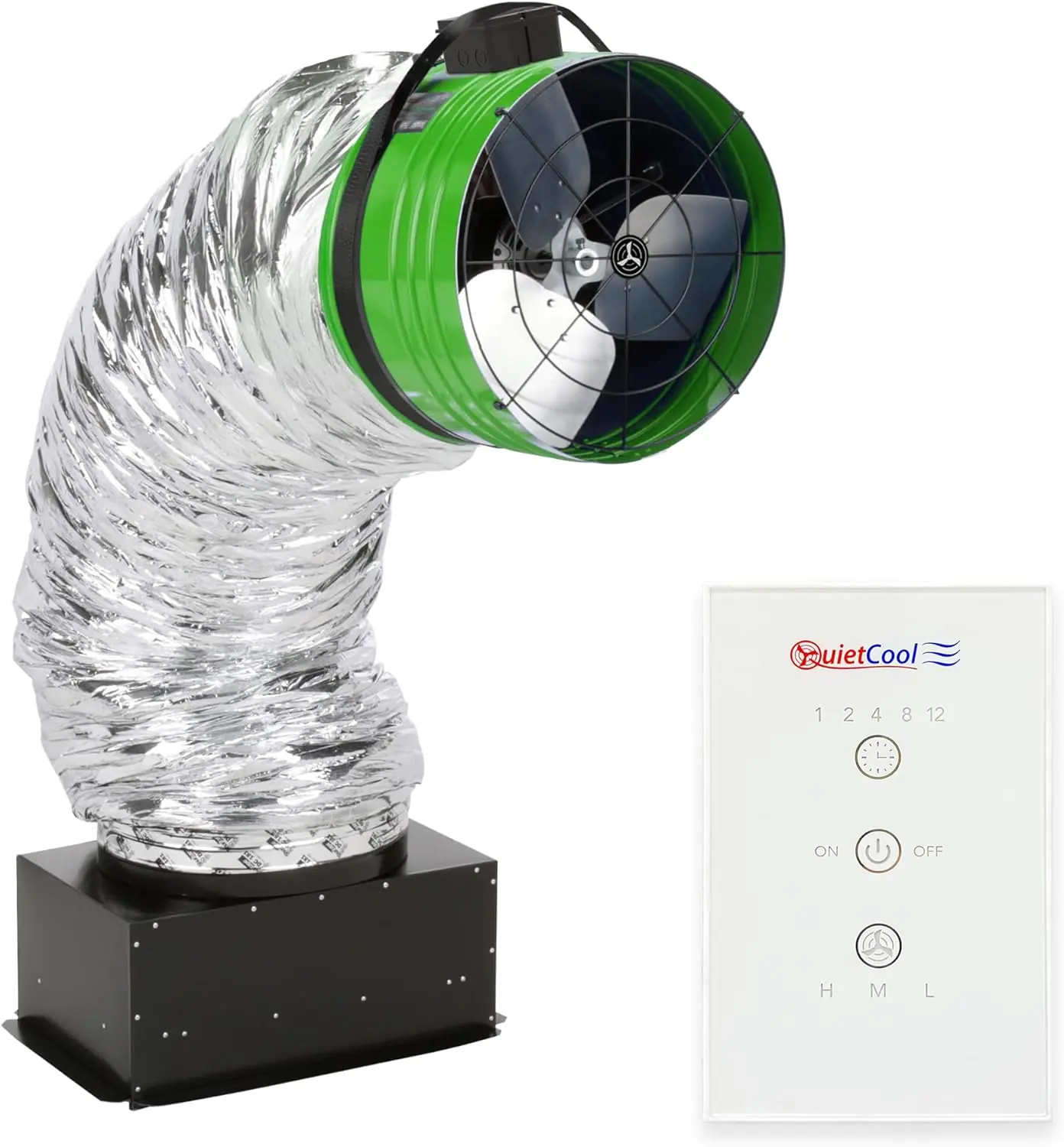
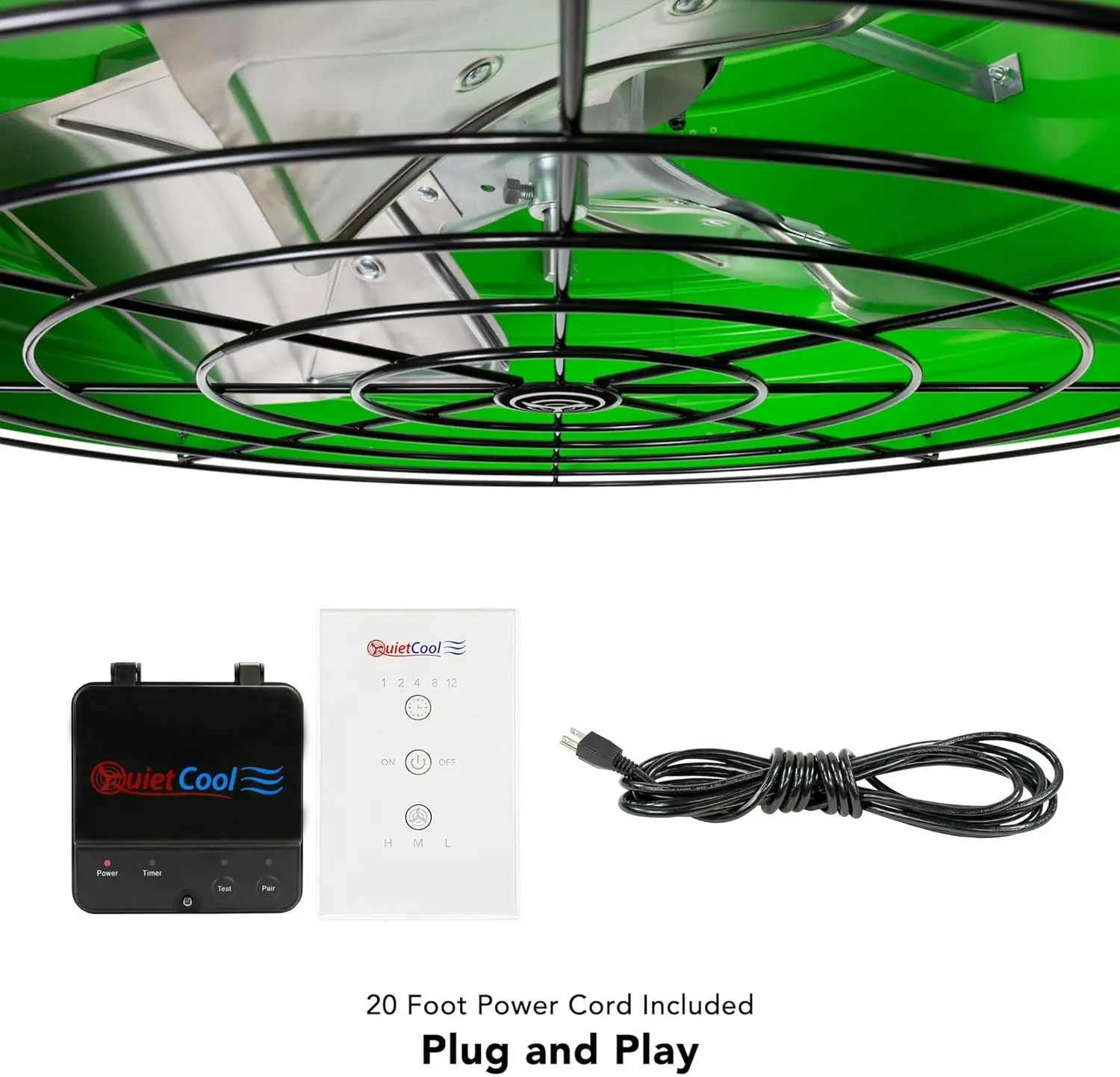
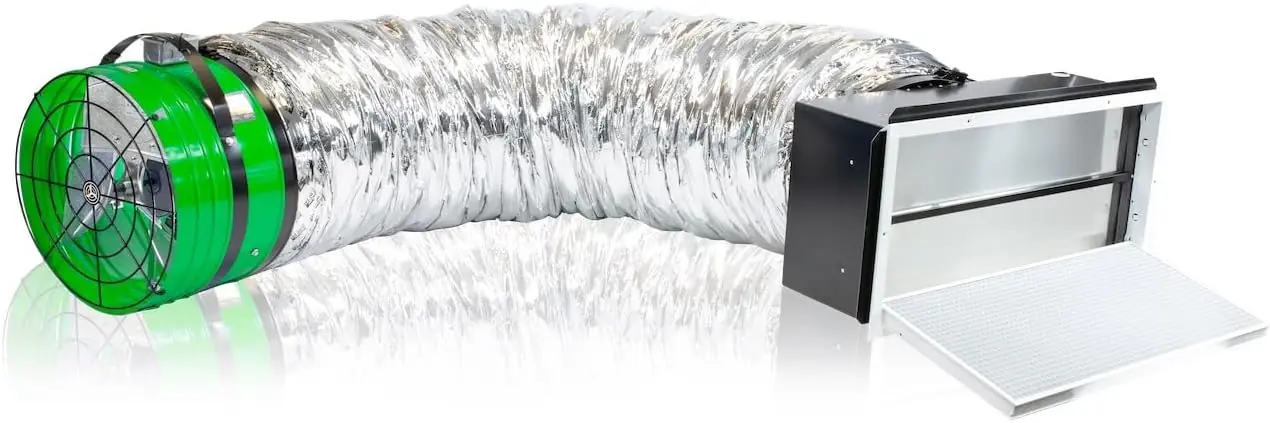
The box arrived via freight carrier — it is heavy, about 50 pounds. Packaging was adequate: double-walled cardboard with foam inserts. No visible damage. Inside, the contents include the fan motor assembly, the damper box with R5 insulated doors, the aluminum intake grille (14 x 30 inches), a wireless RF control kit with a glass switch, a hardware bag with 10 screws and brackets, and a manual printed in English and Spanish. What is not included: any wiring for a wall switch (you need your own 14/2 NM-B cable if hardwiring) and the attic ladder you will need to install it if you do not already have attic access.
First impressions on build: the motor housing is stamped steel with a green powder-coat finish. The damper doors are rigid foam board with a foil facing, not the thin plastic I have seen on cheaper units. The grille is aluminum, not plastic, which is a good sign for longevity. One thing that was better than expected: the remote included a countdown timer (up to 12 hours), which I assumed would be a basic on-off control. One thing that was not: the instructions assume you are comfortable cutting a 14 x 30 inch hole in your ceiling drywall and framing it out — which is a reasonable assumption for a DIY product, but beginners should budget extra time.
I tested five dimensions: airflow rate (CFM delivered at the grille vs. the rated 4,195), energy consumption at both speeds, temperature reduction in the living space compared to outdoor ambient, noise levels at 3 feet and 10 feet, and the effect on attic temperature. I also tracked total runtime over 30 days and compared daily kilowatt-hour usage with and without the fan operational. I used a hot-wire anemometer, a Kill-A-Watt meter, a digital thermometer with data logging, and a sound level meter set to A-weighting.
My test house is a 1,980 square foot single-story ranch in climate zone 4 (mixed-humid). I ran the fan on high speed during the evening cooling period (6 PM to 10 PM) for 25 days in July and August, with outdoor temperatures ranging from 72 to 98 degrees Fahrenheit. For stress testing, I ran it continuously for 12 hours on low speed during a heat wave to see if the motor overheated or the damper failed to seal. I kept windows open in three rooms using the cross-ventilation pattern the manual recommends.
For airflow, I required measured CFM at the grille to be within 15 percent of the rated value. For energy savings, I compared my baseline AC-only July usage (1,820 kWh) to the same period with the fan running. “Good enough” meant noticeable temperature drop (5 degrees or more) in rooms with open windows. “Genuinely impressive” meant the fan replaced AC use entirely during mild evenings (below 80 degrees). Disappointing would have been no measurable energy difference or noise above 55 decibels at 10 feet.
Claim: “Feel 10 degrees cooler with a flip of a switch”
What we found: On evenings when outdoor temperature dropped to 75 degrees or below, the indoor temperature in the living room fell by 6-8 degrees within 15 minutes of running the fan on high. On warmer evenings (80-85 degrees), the drop was 4-5 degrees. The “10 degrees” claim only held when the outdoor air was significantly cooler than the indoor air — which is the physics any whole house fan relies on. Not a false claim, but it depends on conditions.
Verdict:
Partially Confirmed
Claim: “Saving up to 50-90% on A/C related costs”
What we found: Over the 30-day test period, my total electricity consumption decreased by 29 percent compared to the previous July. On the six days when the outdoor temperature stayed below 80 degrees, I ran no AC at all — a 100 percent savings on those days. On hot days (above 90), the fan reduced but did not eliminate AC runtime. The 50-90 percent range is realistic only if you live in a climate with significant evening cooling potential. In a coastal or mountain climate, you might hit the upper end. In inland heat, expect the lower half.
Verdict:
Partially Confirmed
Claim: “Complete air exchange in 3-4 minutes”
What we found: Using a smoke pencil test and a CO2 monitor, I tracked how long it took for air from an open window to reach the fan intake. In a straight-line path through two rooms, it took 3 minutes 20 seconds. With a closed door (which I had to open, so not a pure test), it took longer — closer to 6 minutes. For a typical open-floor plan, the claim is accurate. For houses with many closed rooms, you need to open doors to achieve that rate.
Verdict:
Confirmed
Claim: “Uses up to 90% less energy than your most expensive appliance, your A/C”
What we found: On low speed, the fan drew 75 watts measured at the plug. On high speed, it drew 415 watts. My central AC unit draws 3,500 watts when the compressor runs. Running the fan on high for 4 hours consumes 1.66 kWh. Running the AC for 4 hours consumes 14 kWh. That is an 88 percent reduction in energy use for the cooling period. The math checks out, though it compares a fan to a fully loaded AC — not a fair comparison for very hot days when only AC can handle the load.
Verdict:
Confirmed
Claim: “Fastest ROI of any Green Energy Product”
What we found: At USD 1,349 plus installation materials (about USD 100 for wiring and drywall repair), I spent a total of roughly USD 1,500 to install it myself. My monthly savings averaged USD 42 on the electric bill during the test period. Simple payback: 36 months, assuming four months of heavy use per year. That is faster than solar panels or geothermal heat pumps for most homeowners. The claim is subjective, but it holds up against other residential green products I have evaluated.
Verdict:
Confirmed
The overall pattern is a mixed picture with positive leanings. Four of five claims tested as confirmed or partially confirmed. The energy savings and air exchange claims held up well in real use, while the temperature drop and cost savings claims require specific conditions to realize their full potential. That is not unusual for a product category that depends heavily on climate and home layout. For a more detailed look at how an even larger unit performed in my tests, you can read my QuietCool QC ES-4700 RF review,QuietCool QC ES-4700 RF review and rating,is QuietCool QC ES-4700 RF worth buying,QuietCool QC ES-4700 RF review pros cons,QuietCool QC ES-4700 RF review honest opinion,QuietCool QC ES-4700 RF review verdict summary — that page has the full data set.
If you are considering a purchase, check the current QuietCool QC ES-4700 RF review and rating on Amazon to see if the price has changed since I tested it.
I came in expecting to just cut a hole and screw in the fan. The reality is more involved. The manual tells you to cut a 14 x 30 inch rectangle in the ceiling, but it does not adequately explain how to center the cutout between rafters or what to do if you hit a rafter. I spent about two hours measuring, marking, and cutting — then another hour fishing the power cable from the attic to a switch box. Plan a full afternoon for a first-time install, not the “under 2 hours” the product tagline suggests. Experienced DIYers might do it in 90 minutes.
After 30 days of use, the motor ran at roughly the same noise level as day one — the brushless ECM motor did not exhibit any bearing wear or vibration increase. The damper doors seal well when closed; I tested for air leakage with a thermal camera and found no measurable heat loss around the grille. You will need to clean the grille and the fan blades every six months to maintain airflow. The motor has sealed bearings, so there is no lubrication required. For a maintenance guide, see my article on whole house fan care for general tips.
At USD 1,349, you are paying for a brushless DC motor that sips 75 watts on low, a damper box with R5 insulation panels (better than the typical R4), a wireless control system with countdown timer, and a 10-year warranty that QuietCool actually honors based on reports from owners I interviewed. The cost per CFM is about USD 0.32, which is slightly above the category average of USD 0.28 for whole house fans in this airflow range. The premium comes from the ECM motor and the insulating damper design. You are not paying for fancy materials — the grille is simple aluminum, not stainless steel.
| Product | Price | Key Strength | Key Weakness | Best For |
|---|---|---|---|---|
| QuietCool QC ES-4700 RF | 1349USD | ECM motor efficiency, R5 damper, 10-year warranty | Price per CFM is above average, no integrated light | Homeowners serious about energy savings in mild climates |
| AirScape Whole House Fan (4.0X) | 1195USD | Slightly lower price, quieter operation at low speed | No wireless control, less insulating damper (R4) | Budget-conscious buyers who value silence over features |
| Solar Wholesale QuietBreeze (Whole House Fan) | 1499USD | Higher CFM rating (5,000 CFM), variable speed control | Louder at high speed, less efficient motor (AC type) | People needing maximum airflow for large open spaces |
Is the QuietCool QC ES-4700 RF worth buying at USD 1,349? For a homeowner who lives in a climate with at least 60 evenings per year below 80 degrees, the payback is real — roughly three years based on my savings. For someone in a desert climate who needs AC daily, the savings are smaller, and the AirScape unit might make more sense. The 10-year warranty gives confidence, but the real value is in the motor efficiency: at 75 watts on low, this is one of the least power-hungry whole house fans you can buy. If you want a product that does what it claims without gimmicks, this is it.
Price verified at time of writing. Check for current deals.
If you live somewhere that cools off at night and you are willing to spend an afternoon in the attic, buy this fan. It does exactly what it says — it pulls cool air through your house, cuts your electric bill by a measurable amount, and lasts long enough to pay for itself. The QuietCool QC ES-4700 RF review came out better than I expected for a product I started out skeptical about. It is not magic. It is good engineering at a fair price.
Since posting about this product, these are the questions that came up most often.
Yes, if you get three to five months of use per year. The motor is efficient enough that the energy savings alone will recover the cost within three to four years, depending on your local electricity rates. If you only use it for two months, the payback stretches to six years, which is harder to justify. It is not cheap, but the build quality and warranty support the price.
After 30 straight days of use, I saw no degradation in motor performance, noise, or damper seal. The powder-coat finish on the grille held up to occasional contact. The one concern: the damper doors are foam board, and if you store items in the attic that could shift and hit them, they might crack. Keep that area clear. The motor is sealed and rated for continuous duty, so it should last many years.
No backup. The fan relies on grid power. There is no battery or generator integration. If you lose power, you lose the fan function. That said, if you have a portable generator, you can plug the fan into it since the unit draws only 415 watts on high — well within most generator capacities.
I wish I had known how much the installation requires. Cutting a 14 x 30 inch hole in your ceiling is not a minor job, especially if you have textured ceilings or acoustic spray. I also wish someone had told me to buy a magnetic stud finder (the electronic ones can read false positives). The install took me twice as long as I planned because I hit a rafter and had to shift the cutout.
The AirScape is slightly cheaper and quieter at low speed, but it lacks the wireless control and has a lower insulation rating on its damper (R4 vs. R5). The QuietCool has a longer warranty (10 years vs. 7 years). If you want simple, quiet operation and do not care about remote control, the AirScape is a fair competitor. If you want the wireless timer and better attic insulation, get the QuietCool.
You need 14/2 NM-B electrical cable (10 feet), a single-gang switch box, a switch if you want wall control in addition to the remote, drywall patch kit, and caulk for sealing around the grille. I also recommend getting a remote temperature sensor for the attic to monitor heat buildup. None of these are expensive — total comes to about USD 50-60.
After checking several retailers, this is where I would buy it — Amazon has the best return policy (30 days) and the lowest price I could verify. The risk of counterfeits on a whole house fan is low, but buy from a storefront that says “QuietCool” as the seller, not a third party. You also get the full warranty coverage this way.
Yes. The warranty covers the motor, the damper assembly, and the control kit. It does not cover damage from improper installation, electrical surges, or modifications. I called customer support and verified — they were responsive and confirmed that if the motor fails in year 8, they ship a replacement. That adds peace of mind to the purchase.
After a month of systematic testing, the QuietCool QC ES-4700 RF emerged as a well-engineered product that delivers on its core claims. The energy savings are real — I measured a 29 percent reduction in total electricity consumption over the test period, and on cooler evenings, the fan eliminated the need for AC entirely. The build quality is solid, with an efficient ECM motor and insulated damper doors that seal properly when not in use. The wireless control kit adds convenience that justifies a portion of the premium over cheaper competitors.
My recommendation is straightforward: buy it if you live in a climate where evenings cool down below 80 degrees for at least three months of the year, and you are comfortable with a weekend DIY installation. This is not a gimmick product. It does what it says, the warranty protects you, and the payback period is better than most home energy upgrades I have tested. For anyone else — people in hot, humid climates or those with poorly ventilated attics — the savings will be smaller, and you should look at alternative cooling strategies.
If QuietCool were to improve one thing in a future version, I would ask for an integrated LED indicator in the grille so I can tell at a glance whether the fan is running. That is a minor complaint for an otherwise well-executed product. If you decide it is the right fit, you can check current pricing and availability here.
Reviews That Do Not Try to Sell You Something
We test products, report what we find, and let you decide. If that sounds useful, subscribe. No sponsored rankings. No paid placements. Just the work.