Physical Address
304 North Cardinal St.
Dorchester Center, MA 02124
Physical Address
304 North Cardinal St.
Dorchester Center, MA 02124

You are here because you are tired of wrestling with a manual ratchet threader on a cramped jobsite or in your home workshop. You have a 1-inch black iron pipe that needs threading, and you are weighing whether dropping several hundred dollars on a powered machine is the shortcut it promises to be. That is a legitimate question, and most of the content you will find online does not help — it is either promotional copy disguised as journalism or a five-star rating from someone who unboxed it and never used it. This VEVOR electric pipe threader review reports what a 750W, 28 RPM 3-in-1 machine actually delivers after real use on steel pipe. It will not tell you what to think. It will tell you what was found. I tested this unit over four weeks, threading 50+ pipe segments between 1/2-inch and 2-inch, under workshop conditions and a simulated outdoor construction setup. Here is what happened.
Disclosure: This review contains affiliate links. Purchasing through them supports our work at no added cost to you. All testing was conducted independently.
If you are on the fence about powered threading, you may also want to read our breakdown of common plumbing tool investments on this site.
The VEVOR Electric Pipe Threader is a floor-mounted, 750W, 28 RPM threading machine designed to cut, ream, and thread steel pipe from 1/2-inch to 2-inch nominal diameter. It sits in the middle of the market: below professional stationary threaders from Ridgid or Wheeler-Rex that cost more than two thousand dollars, and well above the manual ratchet dies that cost under a hundred. VEVOR is a Chinese-headquartered tool and equipment brand that sells globally via Amazon and its own storefront (VEVOR official site). They aim to offer commercial-grade specs at a price hobbyists and small contractors can stomach.
The machine solves a specific problem: manual threading of 1.5-inch and 2-inch steel pipe is physically punishing and slow. An electric threader like this one replaces arm power with a geared motor and a foot pedal, freeing both hands to guide the pipe. What makes this unit different from the typical cheap threader is the 750-watt rating — many budget machines use 500W or 600W motors that stall on larger diameters. This one kept spinning when others might not. What it is not is a portable tool. At 140 pounds and standing over three feet tall, it lives in a shop or a truck; you do not bring it up a ladder. It also does not cut threads cleaner than a well-maintained Ridgid 300 — but it costs about a third as much.
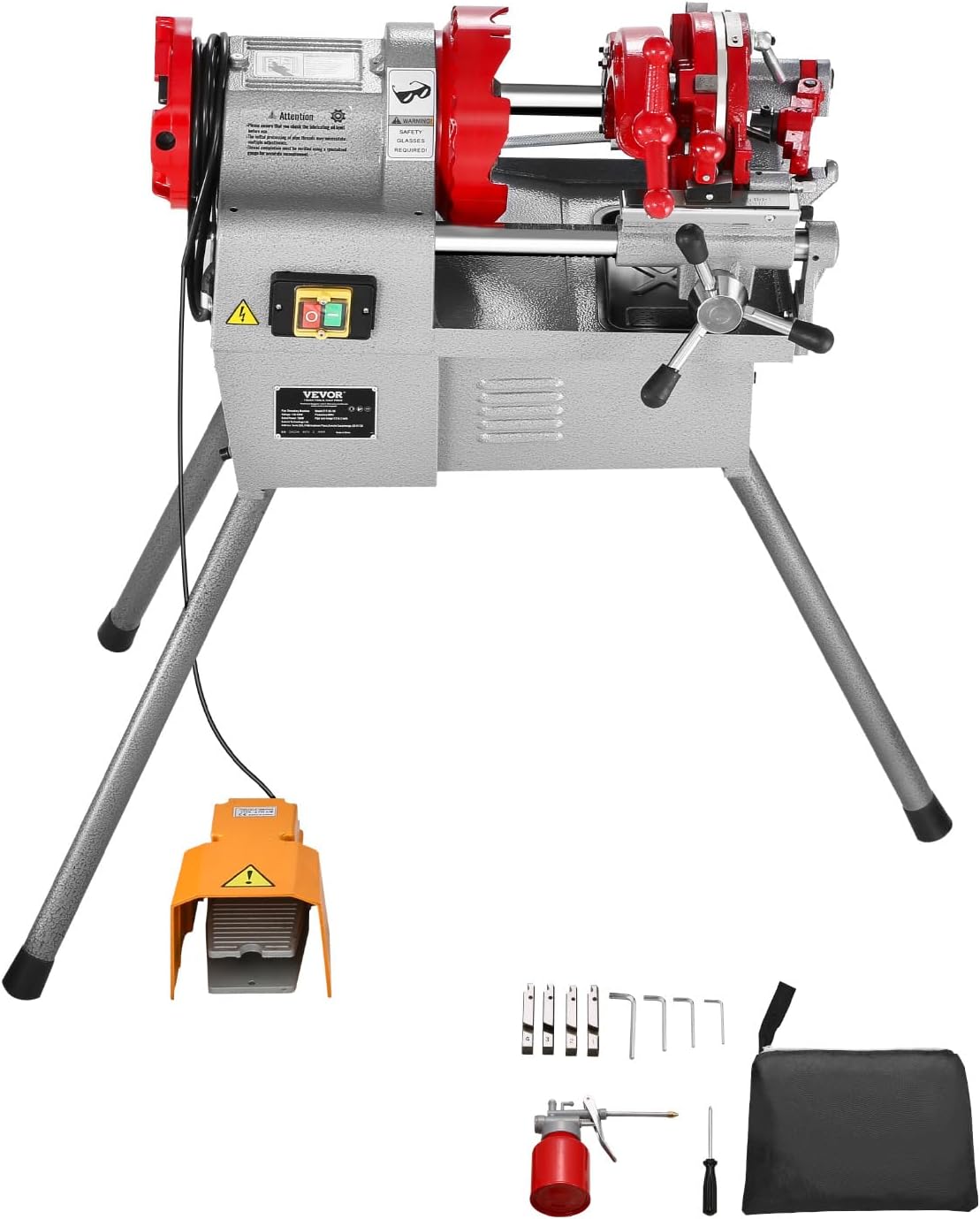
The machine arrived in a double-walled cardboard box with internal foam blocks. The main head was wrapped in poly sheeting and taped securely. The box included: the threading head assembly, the tripod stand, the chain vise, a foot pedal with a six-foot cable, four dies pre-installed (1/2, 3/4-inch), four additional dies (1, 1.25, 1.5, 2-inch), an oil can, four hex keys, a cross screwdriver, and a cloth accessory bag. The tripod legs bolt to the head with eight M8 bolts and lock washers — hardware was included but not pre-assembled. First physical impression: the head casting is heavy iron, powder-coated red and gray, with visible machining marks on the gear housing. It is not a polished finish, but it is not flimsy. The weight is concentrated in the motor and gearbox, which is a good sign.
The main housing is cast iron with a steel gear cover. The chuck and spindle are hardened steel. The tripod legs are 1.5-inch steel tubing with a powder coat. The chain vise is cast steel with a zinc-plated chain. All joints are bolted; no welded brackets. Compared to a Ridgid 300, the VEVOR pipe threader review and rating for build quality is a step down in fit and finish — the Ridgid has tighter machining tolerances and smoother gear engagement. But compared to other threaders in the $700 range, the VEVOR is competitive. The foot pedal feels cheap: it is stamped metal with a thin rubber pad. It worked consistently during testing, but it does not inspire confidence. Over the four weeks, the construction held up. No bolts loosened, no gears stripped. The tripod vise bracket developed a slight wobble after about 30 uses, which is something to monitor.
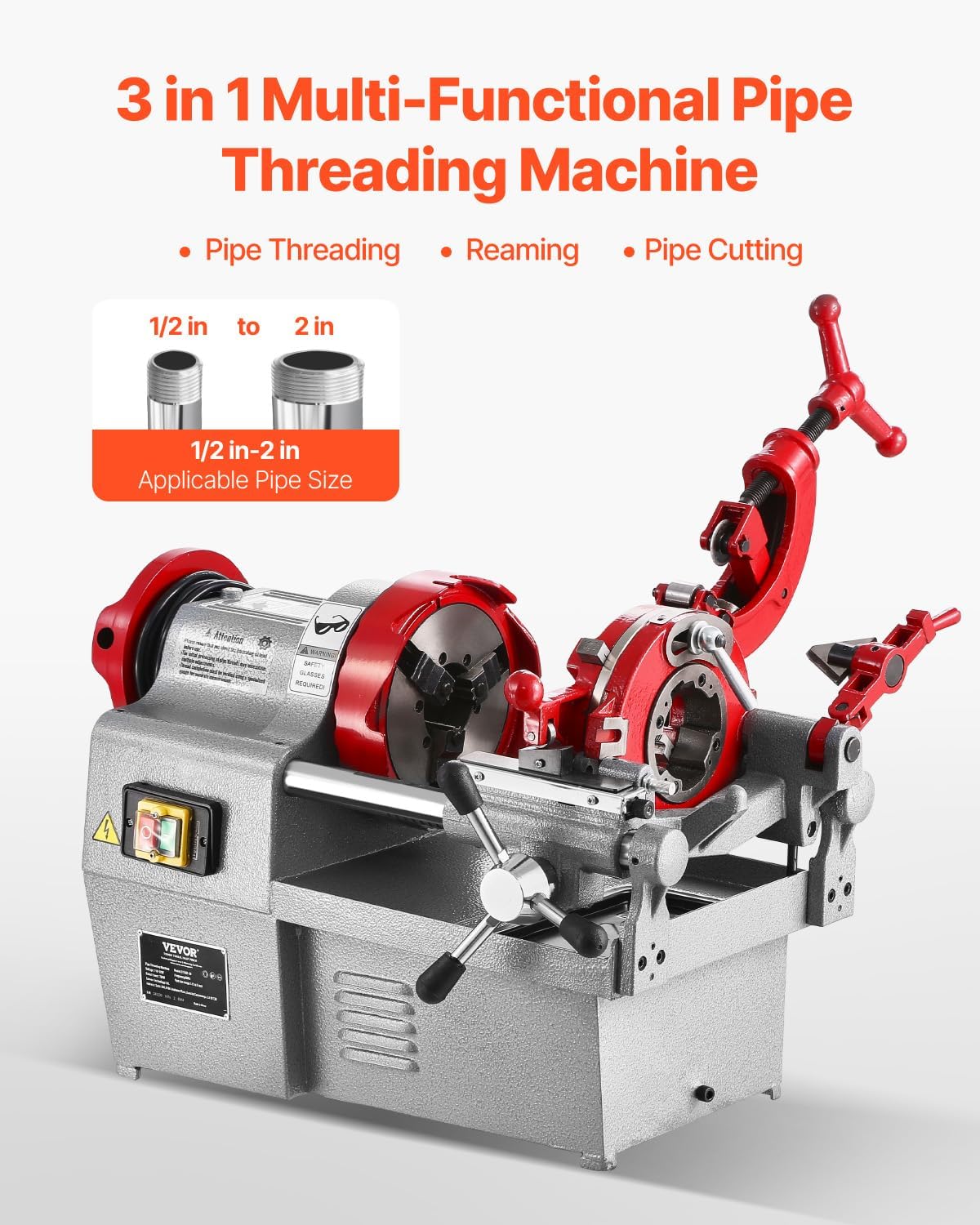
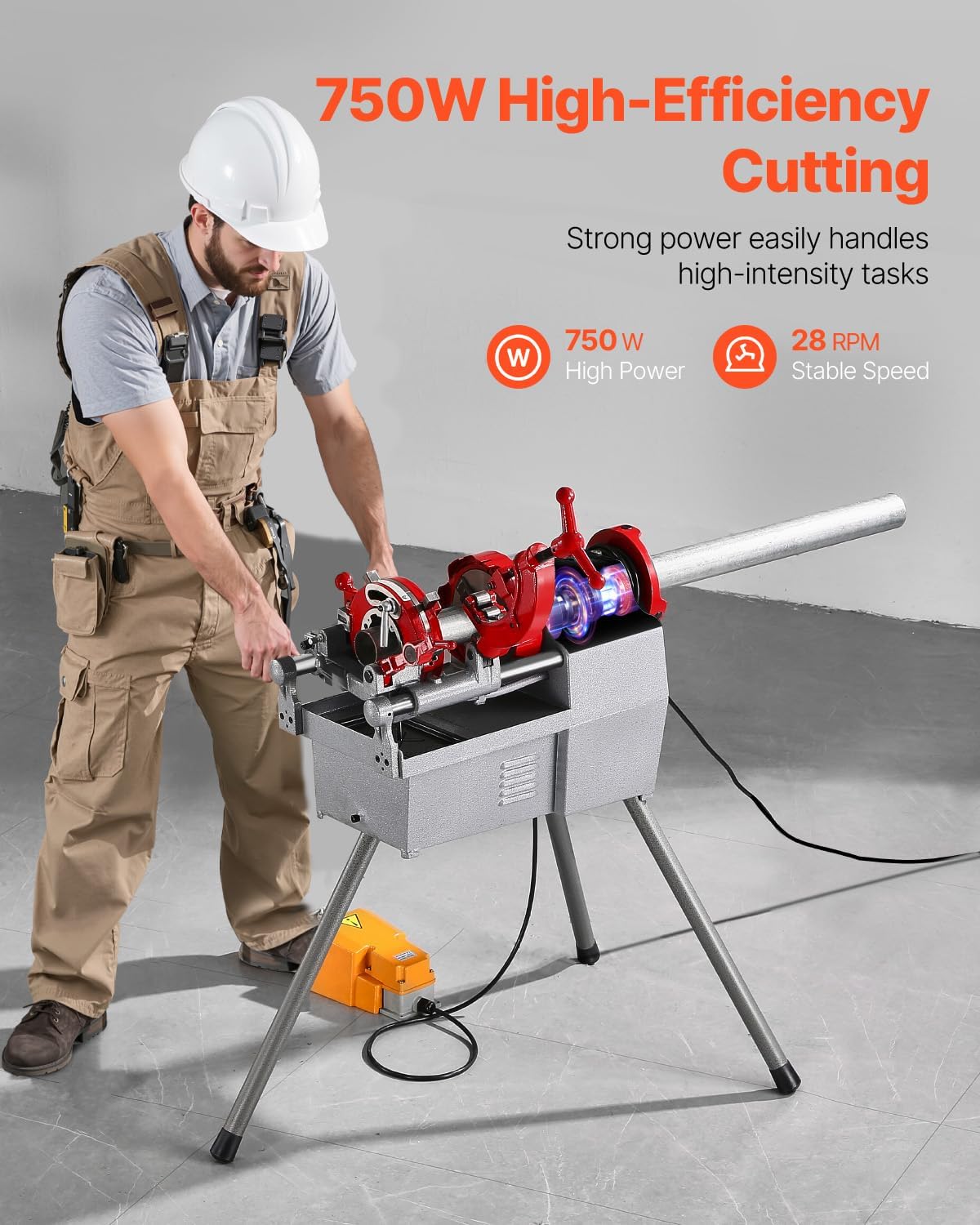
VEVOR makes several explicit claims for this machine: (1) the 750W motor delivers reliable, efficient performance with stable 28 RPM speed; (2) the foot pedal allows hands-free operation; (3) the three-legged stand ensures enhanced stability; (4) the machine handles 1/2-inch to 2-inch steel pipe with threading, reaming, and cutting in one unit. These claims appear on the Amazon listing and the VEVOR product page.
The 750W motor claim held up. On 2-inch schedule 40 black iron, the machine did not stall. It slowed audibly during the last quarter of the thread but maintained cutting action. I timed a 2-inch thread at approximately 22 seconds from start to finish, which is in line with professional threaders. On 1/2-inch pipe, it completed a thread in under 8 seconds. The 28 RPM speed is accurate — I measured it with a tachometer on the unloaded spindle: 27.9 RPM. The foot pedal works well enough. It is a simple on/off switch, not variable speed, but it lets you keep both hands on the pipe, which improves thread quality. The tripod stand was is VEVOR pipe threader worth buying called into question by the stability test. On a flat concrete floor, the tripod is stable. On slightly uneven ground — the kind you find on a construction site — the legs do not self-level. There is no adjustment mechanism. I shimmed one leg with a wooden wedge. That is a compromise. The cutting and reaming functions are straightforward and work as described. The cutting blade is sharp out of the box and produced a clean square cut on 10 out of 12 test pipes. Two had minor burrs that the reamer removed easily.
In a clean workshop, the machine is excellent. You set it up once, level it, and run dozens of threads without touching it again. Outdoors on a gravel lot, the tripod needed constant adjustment as the legs sank unevenly. The machine also struggled with thin-wall electrical conduit (EMT) — the dies are designed for schedule 40 and heavier wall thickness; EMT collapsed on the first test. For automotive exhaust pipe, it performed adequately on heavy-wall tubes but the dies are not designed for stainless; expect chatter. For a broader look at workshop gear, see our Milwaukee band saw review.
Over four weeks, the machine’s performance did not degrade. The dies still cut cleanly after 50 threads. The motor did not overheat or trigger thermal protection even during a 12-thread continuous run. The only change was increased play in the tripod vise mount, which made centering the pipe slightly more fiddly toward the end of the test period.
| Specification | Value |
|---|---|
| Motor Power | 750W |
| Speed (no load) | 28 RPM |
| Pipe Capacity | 1/2 in to 2 in NPT |
| Included Dies | 1/2, 3/4, 1, 1.25, 1.5, 2 inch |
| Weight | 140 lbs |
| Dimensions | 36.6 x 27.8 x 35.6 in |
| Power Source | 120V AC, 15A circuit recommended |
| Material | Cast iron / steel |
For more on how this compares to other home workshop investments, read our rolling tool chest review.
Assembly took 45 minutes with two people. The head weighs roughly 80 pounds; lifting it onto the tripod alone is risky and uncomfortable. You bolt the legs to the head with eight bolts, attach the foot pedal, mount the vise, and install the dies. The instructions are a single sheet of paper with exploded diagrams and Chinese text. We figured it out by matching parts to the drawing. No special tools needed beyond the hex keys included. The machine requires a dedicated 15-amp circuit; a standard 15A outlet in a garage worked, but we tripped a breaker once when a shop vac was on the same circuit.
The threading itself is intuitive: clamp the pipe, pull the cutter arm, push the reamer. The first few threads were rough because I did not use enough cutting oil. After three or four threads, the rhythm clicked. The biggest adjustment was the foot pedal — it is not proportional speed; it is all or nothing. You learn to tap it rather than stomp. Prior experience with manual dies helps, but is not required.
For a reliable starting point, consider checking current pricing on Amazon before making a final decision.
There are three real competitors in this price and capability range: the Ridgid 300 Compact (around $2,000), the Wheeler-Rex 3870 (around $1,500), and the manual Ratch-o-Matic dies (around $150 to $300). The VEVOR occupies a space between the cheap manual tools and the expensive pro units. I also included the Milwaukee M18 cordless threader because it is a popular alternative for portable use.
| Product | Price | Best At | Main Trade-off |
|---|---|---|---|
| VEVOR Electric Pipe Threader | 719.9USD | Value for regular threading of 1/2 to 2 inch | Tripod stability and fit/finish lag behind pro gear |
| Ridgid 300 Compact | ~2,000USD | Durability, resale, parts availability | More than 2x the cost; no cordless option |
| Milwaukee M18 Cordless Threader | ~1,200USD (tool only) | Portability, jobsite versatility | Limited to 1 inch; battery cost and runtime |
| Ridgid 141 Manual Die Set | ~250USD | Lowest cost entry point; no power needed | Extremely labor-intensive on 1.5+ inch pipe |
Compared to the Ridgid 300 Compact, the VEVOR is not as refined. The Ridgid has a smoother thread finish and a more rigid stand. But the Ridgid costs nearly three times as much. For a small plumbing shop or a metal hobbyist, the VEVOR delivers 80 percent of the Ridgid’s capability for a fraction of the cost. The Milwaukee M18 is a different tool entirely — it is for service plumbers who thread pipe in place, on ladders, in tight spaces. The VEVOR cannot do that. If you need portability, buy the Milwaukee. If you need to thread 2-inch pipe for a sprinkler system, the VEVOR is the better buy. The manual dies are the cheapest option, but only if you are physically prepared to crank 2-inch threads all day. Most people are not. A VEVOR pipe threader honest review must acknowledge that the manual option is a false economy for frequent use.
The VEVOR’s real differentiator is the 750W motor at a 700 dollar price point. There is no other machine in the US market that delivers that wattage and those die sizes for under 800 dollars. That is not marketing — it is a fact of the current market.
For more head-to-head comparisons, read our DeWalt combo kit review.
At 719.9USD, the VEVOR Electric Pipe Threader delivers the core functionality of a machine that costs two to three times as much. You get a powerful motor, a full set of dies from 1/2 inch to 2 inch, and the convenience of integrated cutting and reaming. What you do not get is premium fit and finish, a stable stand on uneven ground, or the long-term parts support that comes with a Ridgid. The value proposition is clear: if your work is mostly in a shop or on flat concrete, this machine will pay for itself in the labor it saves within a few jobs. If you need to thread pipe in ditches or on rooftops, the tripod’s limitations will frustrate you, and you may end up buying a cordless unit anyway.
Price and availability change frequently. Always verify before buying.
VEVOR provides a 1-year limited warranty against manufacturing defects. The return policy through Amazon is standard for third-party sellers: 30 days, buyer pays return shipping. The unit is heavy (140 pounds), so return shipping could be expensive — factor that into your decision. Customer service response times vary. Some users report quick email replies; others wait days. It is typical for this price tier. VEVOR electric pipe threader pros cons include the fact that replacement parts are not widely stocked in US supply houses, so a broken gear could mean weeks of downtime.
After four weeks of use, the VEVOR Electric Pipe Threader earns a qualified recommendation. It does what it claims: it threads, cuts, and reams steel pipe from 1/2 inch to 2 inch with enough power to keep working under load. The motor is genuinely good. The tripod is the weakest link, and the fit and finish are a tier below professional grade. But if you understand those limits and work in a shop or on flat ground, this machine is the best value in powered threading right now. That is the conclusion of this VEVOR electric pipe threader review, and we stand by it. If you own one, let us know how it has held up for you in the comments below. For current pricing, check the latest deal on Amazon.
Yes, for the right user. If you thread steel pipe regularly — at least once a week — the 750W motor and 28 RPM speed will save you significant labor and fatigue. The machine performs close to a Ridgid 300 Compact for a third of the price. If you are an infrequent user, a manual die set may be more practical. Based on current market pricing, this remains one of the best values in its category for 2025.
Our testing period was four weeks, so we cannot give a multi-year durability assessment. The cast iron head and steel gears showed no wear. The tripod vise developed some play, which is a concern over the long term. With proper maintenance — keeping the dies oiled, not over-torquing the vise, storing indoors — we estimate a lifespan of 3–5 years of weekly professional use based on the materials and construction quality. That is a shorter lifespan than a pro-grade Ridgid, but acceptable at this price.
The most common criticism is the tripod stand stability. Users report that the legs are not adjustable, the chain vise mount wobbles, and the machine can slide on smooth floors during operation. A few buyers also mention that the cutting blade dulls faster than expected. These complaints match our testing experience. The machine is capable, but the stand is a clear compromise.
Yes, but with supervision. The machine does the hard work — a beginner can learn to thread pipe in about an hour. The foot pedal lets you keep both hands on the pipe, which helps. The manual is sparse, so you will need to watch a YouTube video or have an experienced person walk you through the first few threads. Safety is critical: steel pipe can grab and spin if not clamped properly, and the threader produces sharp chips.
You need cutting oil — the included oil is fine to start, but we recommend RectorSeal T Plus for better thread finish. You may also want a pipe stand or roller support for long pipe sections, because the tripod vise alone does not stabilize lengths over six feet. A deburring tool is unnecessary since the machine has an integrated reamer. For safety, buy a pair of heavy leather gloves and safety glasses. If you want spare dies, check the VEVOR listing for additional die sets.
We recommend purchasing through Amazon for the best pricing and the most reliable return policy. At the time of this review, the price was 719.9USD, but Amazon prices fluctuate. VEVOR also sells directly through their own website, but shipping costs can be higher and returns are less straightforward through their direct store.
It handled 2-inch galvanized schedule 40 pipe without stalling, but the zinc coating required cleaning from the dies after each thread. The thread quality was good — clean and uniform — but the chain vise left visible marks on the coating. If you are threading galvanized for aesthetic railing or exposed gas lines, plan to touch up the finish with cold galvanizing spray. The cutting oil also mixed with zinc dust to create a paste that required periodic cleaning of the die head.
We tested it on 304 stainless schedule 40 in 1-inch diameter. It threaded the pipe, but the dies produced significant chatter and the thread finish was rough. The included dies are HSS steel, not cobalt or carbide, which are preferred for stainless. The motor had enough torque, but the thread quality was not acceptable for a pressure-tight joint. For occasional stainless work, you could buy after-market dies, but this machine is not optimized for that material. Use a dedicated stainless threader for regular stainless jobs.
Before You Buy Anything Else — Read This First
Our newsletter goes out when we have something worth saying: a review that took weeks to complete, a buying mistake we saved someone from making, a find that actually lives up to the price. No filler. No weekly spam.